- English
- French
- German
- Portuguese
- Spanish
- Russian
- Japanese
- Korean
- Arabic
- Greek
- German
- Turkish
- Italian
- Danish
- Romanian
- Indonesian
- Czech
- Afrikaans
- Swedish
- Polish
- Basque
- Catalan
- Esperanto
- Hindi
- Lao
- Albanian
- Amharic
- Armenian
- Azerbaijani
- Belarusian
- Bengali
- Bosnian
- Bulgarian
- Cebuano
- Chichewa
- Corsican
- Croatian
- Dutch
- Estonian
- Filipino
- Finnish
- Frisian
- Galician
- Georgian
- Gujarati
- Haitian
- Hausa
- Hawaiian
- Hebrew
- Hmong
- Hungarian
- Icelandic
- Igbo
- Javanese
- Kannada
- Kazakh
- Khmer
- Kurdish
- Kyrgyz
- Latin
- Latvian
- Lithuanian
- Luxembou..
- Macedonian
- Malagasy
- Malay
- Malayalam
- Maltese
- Maori
- Marathi
- Mongolian
- Burmese
- Nepali
- Norwegian
- Pashto
- Persian
- Punjabi
- Serbian
- Sesotho
- Sinhala
- Slovak
- Slovenian
- Somali
- Samoan
- Scots Gaelic
- Shona
- Sindhi
- Sundanese
- Swahili
- Tajik
- Tamil
- Telugu
- Thai
- Ukrainian
- Urdu
- Uzbek
- Vietnamese
- Welsh
- Xhosa
- Yiddish
- Yoruba
- Zulu
Best Rugs for Play and Children's Use
When sourcing flooring for children's environments, the stakes are higher than aesthetics. A quality Childs Play Carpet delivers cushioned fall protection, acoustic dampening, thermal insulation, and an interactive learning surface — all within a single product. Unlike standard residential rugs or foam puzzle mats, purpose-built children's play rugs combine pedagogical design with institutional-grade durability. For B2B buyers — from wholesale distributors to e-commerce brands — selecting the right play carpet directly impacts safety compliance, customer satisfaction, and long-term profitability. This guide walks through everything procurement professionals need to know.
Understanding Child Play Carpets – Basics and Benefits
What Sets Play Carpets Apart From Ordinary Rugs
A children's play rug is engineered specifically for active, high-traffic use by young children. Standard area rugs prioritize decorative value; play carpets prioritize safety, durability, and developmental engagement. The surface integrates interactive patterns — road maps, alphabets, number grids — printed directly into the fiber rather than applied as surface coatings that peel over time.
According to the Journal of Environmental Psychology (2019), structured visual environments measurably improve children's focus and spatial reasoning, making design an operational asset, not just a decorative one.
Material composition matters significantly in institutional settings. Polyester fiber — the surface material in Aijia's crystal velvet play carpet line — offers excellent colorfastness, stain resistance, and a soft, skin-friendly touch ideal for children who spend extended time on the floor. Compared to wool (heavier, costlier, sensitive to moisture) or foam tiles (lower durability, limited design options), polyester-backed play carpets consistently outperform in commercial settings requiring frequent cleaning and sustained visual quality.
Safety certification is non-negotiable. Compliant products must pass OEKO-TEX (non-toxic textiles), EN 71 (toy safety in applicable EU markets), REACH (chemical restrictions), and flammability standards such as ASTM D2859 for the US market.

How to Choose the Best Child Play Carpet for Your Business
Key Procurement Criteria Across Buyer Profiles
The "right" Childs Play Carpet varies depending on your distribution channel and end-user environment. Childcare centers prioritize antimicrobial treatment and easy maintenance. Retail brands demand trend-driven designs and private label packaging. Wholesale distributors focus on cost-per-unit, consistent batch quality, and export-ready logistics.
Here are the core procurement criteria that apply across most B2B segments:
- Thickness and cushioning: A 5mm pile height strikes the optimal balance — thick enough to absorb impact and provide warmth, yet thin enough (at just 5mm total) that the carpet won't catch under door clearances. Aijia's play carpet achieves this with a high-density machine-woven crystal velvet surface.
- Weight and density: At 750–1,100 g/㎡ (customizable), the gram weight directly influences underfoot comfort and product longevity. Higher gram weight indicates denser fiber packing, which resists matting under repetitive foot traffic.
- Non-slip backing: Dot plastic (PVC) backing provides reliable grip on hard flooring — vinyl, tile, hardwood — without adhesive residue. This is critical for institutional environments where falling hazards carry liability.
- Stain resistance and quick-drying: The surface treatment on Aijia's crystal velvet line combines stain resistance with water-absorbent, quick-drying performance — an essential pairing for environments where spills are routine.
These criteria collectively reduce procurement risk, minimize after-sale complaints, and support stronger sell-through rates for distributors and retailers alike.
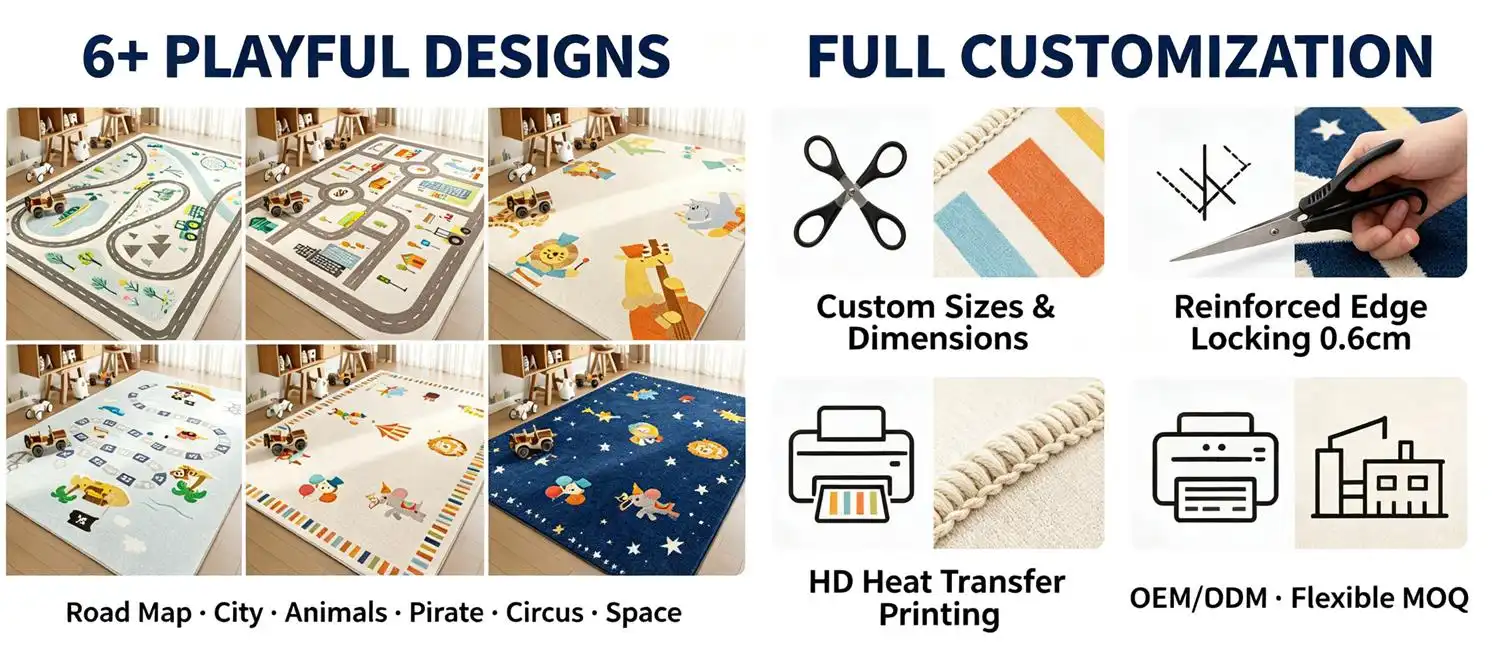
Customization capability amplifies commercial value. OEM and ODM production allow importers and retail brands to differentiate their product lines with proprietary colorways, custom logos, and exclusive pattern designs — all achievable through Aijia's heat transfer and laser cutting infrastructure.
Top Rug Patterns and Designs for Child Play Areas
How Design Drives Engagement and Procurement Confidence
Patterns in children's play environments do meaningful cognitive work. Road map designs encourage spatial awareness and imaginative role-play. Alphabet and phonics grids reinforce early literacy. Geometric and color-block layouts support early math and sensory development. The American Journal of Occupational Therapy (2020) notes that structured floor environments in clinical and educational settings support gross motor skill development in children aged 2–8.
Color psychology also matters commercially. Warm, saturated palettes (red, yellow, orange) stimulate energy and engagement in active play zones. Cooler tones (blue, green) create calmer reading corners. For B2B buyers, offering a curated palette across these categories expands shelf appeal and addresses varied institutional needs within a single product range.
Aijia supports solid color, printed, and fully custom pattern production — including licensed-style educational graphics — with print registration accuracy that preserves fine detail even at scale. High-definition heat transfer technology locks color into the fiber, preventing the pattern fade that undermines customer reviews and return rates.

Maintenance, Safety, and Compliance for Child Play Carpets
Practical Cleaning and Regulatory Navigation
Institutional Child's Play Carpets face aggressive cleaning cycles. High-traffic settings — daycare centers, hotel family suites, retail play zones — require surfaces that respond well to spot cleaning, vacuuming, and periodic wet cleaning without backing delamination or pile distortion.
Aijia's crystal velvet surface with dot plastic (PVC) backing handles routine maintenance without structural compromise. The edge-locking finish (0.6cm reinforced selvedge) prevents fraying under repeated lifting, dragging, and rolling — the real-world stress that degrades cheaper product lines within months.
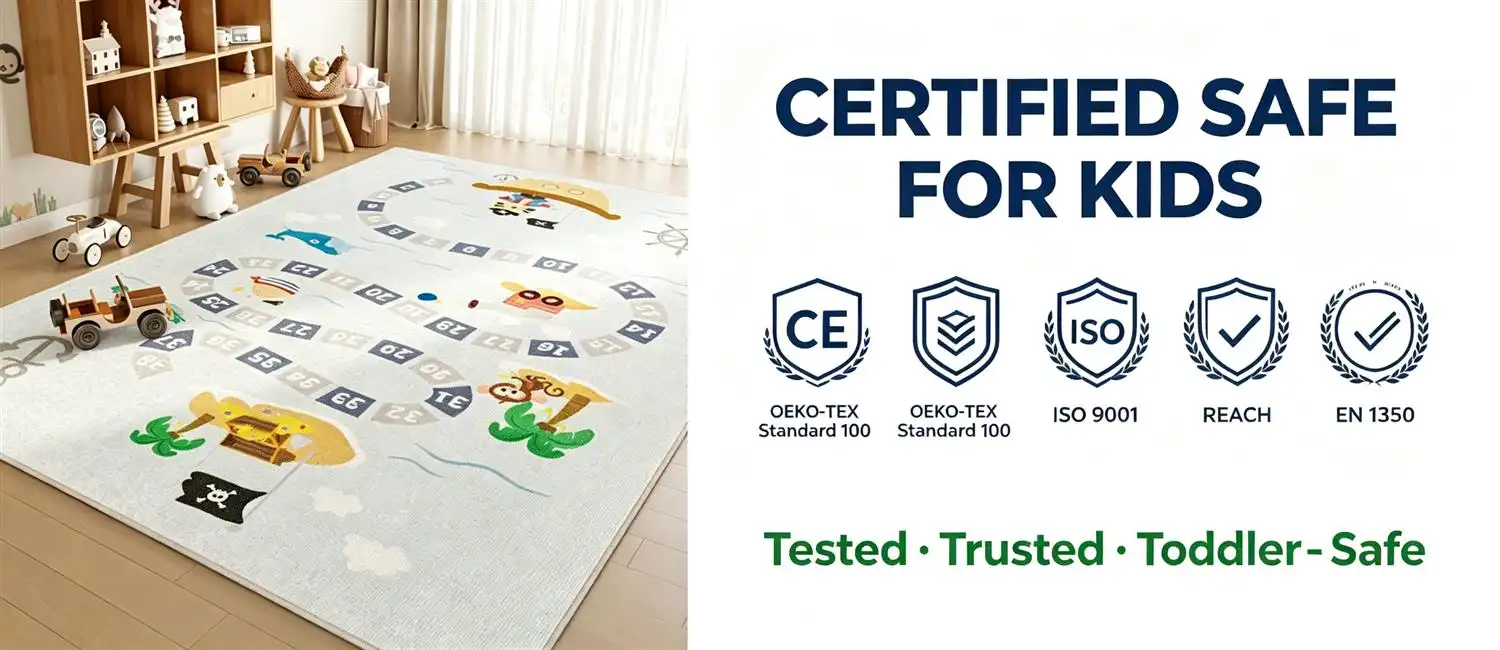
From a compliance standpoint, US importers should verify ASTM D2859 flammability compliance and OEKO-TEX certification for chemical safety. EU distributors additionally require REACH compliance and, for products marketed as educational toys, EN 71 certification. Aijia holds CE, OEKO-TEX, ISO 9001, REACH, and EN 1350 (flame retardant) certifications — covering the regulatory requirements of North America, Europe, the Middle East, and Southeast Asia within a single supplier relationship.
The Consumer Product Safety Commission (CPSC) reports that flooring-related injuries account for a significant share of childhood accidents in institutional settings, reinforcing why non-slip backing and certified flame retardancy are not optional specifications.
Comparing Market Solutions: Best Child Play Carpets for B2B Clients
Matching Product Specifications to Commercial Requirements
The children's play rug market segments broadly into three tiers: mass-market foam tiles, mid-range polyester print rugs, and premium commercial-grade textile play carpets. Each serves different price points and use contexts.
Foam tiles dominate in cost-sensitive residential markets but wear poorly in commercial settings and offer limited design customization. Traditional tufted rugs provide better aesthetics but often lack certified non-slip backing and consistent batch color matching — a persistent pain point for wholesale distributors managing multi-store clients.
Crystal velvet polyester play carpets — with stain-resistant surface treatment, PVC dot backing, and customizable gram weight from 750 to 1,100 g/㎡ — occupy the commercial sweet spot. They deliver the softness and design range that retail buyers demand alongside the durability and compliance documentation that institutional procurement requires.
Washable and eco-conscious options are gaining traction across the US market, particularly among Shopify and Amazon brands targeting millennial parents. Aijia's production process supports eco-friendly material adaptations and custom packaging — including compact roll packaging and carton packaging optimized for cross-border shipping — which directly addresses the logistics cost sensitivity of e-commerce sellers.
With a daily production capacity of 10,000 ㎡ and a lead time of approximately 7 days for orders under 2,000 ㎡, Aijia accommodates both rapid restocking cycles and large project-based procurement without compromising delivery reliability.
Conclusion
Sourcing children's play rugs for commercial or wholesale distribution requires balancing safety, design, durability, and compliance — not just price. Crystal velvet polyester play Childs Play Carpet with non-slip PVC dot backing, stain-resistant surface treatment, and certified safe materials represent the strongest value proposition across most B2B segments. The specifications outlined here — 5mm thickness, 750–1,100 g/㎡ gram weight, full OEM customization capability, and multi-market certification coverage — provide a practical benchmark for procurement decisions.
FAQ
1. What is the ideal carpet size for daycare or preschool settings?
Standard sizes work well for reading corners and circle-time areas, but custom sizing is often necessary for irregular floor plans in institutional buildings. Most daycare operators source carpets in the 2m × 3m range for group areas. Custom dimensions are available through OEM production.
2. Does buying eco-friendly play carpet in bulk significantly increase unit cost?
Eco-adapted materials typically add 8–15% to base unit costs depending on the specification. At bulk order volumes, this premium compresses. For distributors positioning products in premium retail channels, the margin impact is generally recoverable through higher sell-through pricing.
3. How do I verify compliance certifications when importing play carpets?
Request original certificate documents — not photocopies — directly from the manufacturer, including OEKO-TEX, REACH, and relevant flammability test reports. Reputable suppliers provide complete export documentation as standard, reducing customs clearance risk and protecting importers from compliance liability.
4. Can carpet designs be customized for private label programs?
Yes. OEM and ODM production allow full customization of color, pattern, logo, and packaging. Aijia supports heat transfer printing for complex designs and laser cutting for non-standard shapes.
Source Your Next Children's Play Carpet Collection With Aijia
Aijia — a certified Children's Play Carpet manufacturer with 20 years of export-oriented production experience — offers crystal velvet play carpets with flexible MOQ, 24–48-hour sampling, and complete compliance documentation for the US, EU, and global markets. Browse the full product catalog and request a bulk pricing consultation at contact the sales team directly at sales@aijiarug.com to discuss OEM customization and your next order.
References
1. Journal of Environmental Psychology (2019). "Structured Visual Environments and Children's Cognitive Development." Elsevier.
2. American Journal of Occupational Therapy (2020). "Floor-Based Intervention and Gross Motor Skill Development in Early Childhood." AOTA.
3. U.S. Consumer Product Safety Commission (CPSC) (2022). "Home and Recreational Safety: Flooring Hazards and Childhood Injuries."
4. OEKO-TEX Association (2023). "STANDARD 100 by OEKO-TEX: Certification Criteria for Textile Products."
5. ASTM International (2021). "ASTM D2859: Standard Test Method for Ignition Characteristics of Finished Textile Floor Covering Materials."
6. European Chemicals Agency (ECHA) (2023). "REACH Regulation: Understanding Compliance for Textile Importers."
Request fast quotes for bulk carpets, OEM & ODM floor mats, supported by strict quality control and complete supply chain.