- English
- French
- German
- Portuguese
- Spanish
- Russian
- Japanese
- Korean
- Arabic
- Greek
- German
- Turkish
- Italian
- Danish
- Romanian
- Indonesian
- Czech
- Afrikaans
- Swedish
- Polish
- Basque
- Catalan
- Esperanto
- Hindi
- Lao
- Albanian
- Amharic
- Armenian
- Azerbaijani
- Belarusian
- Bengali
- Bosnian
- Bulgarian
- Cebuano
- Chichewa
- Corsican
- Croatian
- Dutch
- Estonian
- Filipino
- Finnish
- Frisian
- Galician
- Georgian
- Gujarati
- Haitian
- Hausa
- Hawaiian
- Hebrew
- Hmong
- Hungarian
- Icelandic
- Igbo
- Javanese
- Kannada
- Kazakh
- Khmer
- Kurdish
- Kyrgyz
- Latin
- Latvian
- Lithuanian
- Luxembou..
- Macedonian
- Malagasy
- Malay
- Malayalam
- Maltese
- Maori
- Marathi
- Mongolian
- Burmese
- Nepali
- Norwegian
- Pashto
- Persian
- Punjabi
- Serbian
- Sesotho
- Sinhala
- Slovak
- Slovenian
- Somali
- Samoan
- Scots Gaelic
- Shona
- Sindhi
- Sundanese
- Swahili
- Tajik
- Tamil
- Telugu
- Thai
- Ukrainian
- Urdu
- Uzbek
- Vietnamese
- Welsh
- Xhosa
- Yiddish
- Yoruba
- Zulu
How to put a rug in a baby's room?
Placing a rug in a baby's room goes beyond simple décor—it's about creating a safe, comfortable, and functional space where infants can explore and develop. A properly selected Rug In Nursery Room provides thermal insulation against cold floors, cushions falls during tummy time, and reduces noise from foot traffic. The process involves choosing non-toxic materials like crystal velvet polyester with dot plastic backing, ensuring slip resistance, and positioning the rug away from cribs to prevent tripping hazards. Proper sizing matters too—the rug should cover high-activity zones without interfering with door clearance or furniture placement.
Understanding the Nursery Rug Landscape
When I talk about nursery flooring with distributors and online sellers, we always come back to the same basic truth: parents won't skimp on safety, and procurement teams shouldn't either. Besides looking nice, nursery rugs are very important for many other reasons. As babies crawl, they keep babies from getting too cold on wooden or tile floors by acting as thermal barriers. They also soften the impact when babies fall, which is especially useful in apartments or homes with more than one child.
Safety and Comfort as Procurement Priorities
Every specification choice is based on how safe it is for babies. Standards for tuft bind strength testing, such as ASTM D1335, make sure that fibers stay anchored in the backing. This keeps loose threads from becoming choking hazards. Chemical safety rules in ASTM F963 make sure that materials don't have any heavy metals like lead, cadmium, or mercury that are dangerous and could leak out when babies eat things. Flammability resistance testing with DOC FF 1-70 makes sure that rugs put out fires on their own instead of spreading them.
For children, comfort means helping them grow. How well a rug absorbs shock when babies roll over or fall is based on its padding factor. A thickness of 5 mm and a density of 750 to 1100 g/m³ are just right—it's soft enough for comfort but firm enough to support stable crawling movements. Crystal velvet surfaces feel good against the skin and encourage you to explore your senses without irritating them.
Balancing Aesthetics with Health Standards
Buyers are always torn between following the latest trends and meeting legal requirements. Scandinavian simplicity and gender-neutral color palettes are popular right now, but these style choices have to be in line with the OEKO-TEX Standard 100 certification, which says that the products don't contain any dangerous substances. Low-VOC (volatile organic compound) emissions protect growing lungs from irritation, which is a must for health-conscious parents and business buyers alike.
Another pain point is taken care of by hypoallergenic materials. Traditional wool mats are strong, but they can make people with allergies sick. Synthetic polyester fibers that have been treated to prevent stains are just as soft as natural fibers, but they don't pose the same risk of allergens. This makes them a better choice for daycares and hospitals where kids with weak immune systems may be present.
How to Choose the Best Rug Material for Nursery Rooms
The choice of material affects how well it works in the long term and how happy the customer is. Depending on the type of nursery—from private homes to public daycares—different materials are needed that are the right mix of cost, sturdiness, and upkeep.
Comparing Core Material Options
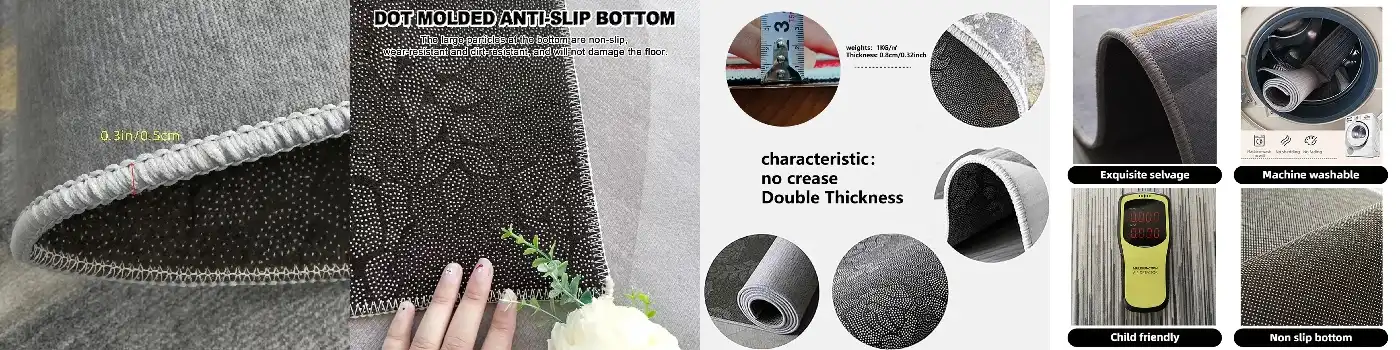
Crystal silk polyester is the best material for use in nurseries right now. Its 5mm pile is soft and won't mat down even after heavy use, thanks to its high-density machine weave. The dot plastic (PVC) backing gives the rug better grip on smooth floors without the need for separate rug pads, which makes placement easier. This mix of materials passes strict colorfastness tests against both water and saliva (ISO 105-E01/E04), so the colors won't run when babies mouth or drool on surfaces.
People who care about the environment like natural fibers like organic cotton, but they need to know what to expect. Cotton is breathable and has GOTS certification, which means it was grown in an environmentally friendly way, but it doesn't resist stains as well as treated synthetics. Jute is very durable and has a high tensile strength, making it perfect for places with a lot of foot traffic. However, its rough texture needs to be mixed with softer fibers to make it more comfortable for babies.
Synthetic mixes like Nursery Room Rug improve a lot of performance measures at the same time. Stain-resistant coatings on polyester fibers keep typical nursery messes like formula, pureed foods, and diaper leaks from happening while keeping the easy-care profiles. Mold can't grow in humid places because the material dries quickly. This is a major health concern for bulk buyers who ship to many different areas.
Key Certification Benchmarks
Procurement experts should check more than one level of compliance. With OEKO-TEX approval, you can be sure that over 100 harmful chemicals, such as flame retardants and pesticides, are not present. REACH (Registration, Evaluation, Authorization, and Restriction of Chemicals) rules say that 219 substances of very high concern can't be sold in the EU. ISO 9001 approval means that the quality management system is consistent, which lowers the risk of variation from batch to batch for big sales.
The CE mark adds another level of security for products being sold in Europe, proving that they meet standards for safety, health, and environmental protection. Flame retardancy ratings under EN 13501 are needed for commercial nurseries in hotels or corporate childcare centers where building codes require certain levels of fire safety.
Step-by-Step Guide to Installing and Using Rugs in Nursery Rooms
When you place a rug correctly, you avoid common problems and get the most out of it. These systematic rules make sure safe and effective placement, whether you're helping store customers or making big orders for daycare chains.
Pre-Installation Assessment
Compatibility between floor types is the basis. Rugs with strong non-slip backing are needed for floors that are smooth, like hardwood, laminate, or tile. The dot plastic on the bottom creates friction through thousands of small contact points, which keeps the ball in place even when it's being played with. When it comes to carpeted nurseries, different solutions are needed. Putting low-pile rugs over high-pile carpeting can be dangerous, so thinner-profile options or getting rid of extra rugs may be needed.
The size plan is based on the size of the room. To make the play area clear, the rug should go at least 18 inches past the edges of the furniture. By measuring the activity center of the nursery—that is, the space between the crib, changing table, and play station—you can tell if normal sizes (3x5 feet, 5x7 feet, 8x10 feet) are enough or if you need to make your own.
Placement Principles for Safety and Functionality
Place rugs away from the paths that doors move through to keep them from bunching up and becoming trip risks. The 5mm width requirement makes sure that it fits under normal inner doors without catching or scraping. Fire safety rules say that emergency exit routes must not be blocked, especially in business settings. Make sure there are clear paths between the crib and the door.
When there are kids playing on bigger rugs, anchor points are important. The dot-patterned plastic back helps with grip, but areas with a lot of foot traffic in daycares might benefit from having heavier furniture around the edges. Putting one edge of the rug under a bookshelf or toy storage unit will keep the corners from curling over time. Do not put blankets right under cribs, as they could get in the way of putting the crib safely away from windows and cords.
Common Installation Pitfalls
The most common mistake is undersizing. If the rug is too small, it doesn't help define the play area and doesn't look right with the other furniture in the room. When something is too big, it bunches up against walls and furniture legs, which looks bad and can be dangerous. Custom sizing services can help with rooms that don't have a normal shape or that have specific useful needs, like L-shaped nurseries or play corners.
Buyers who don't test slip resistance before finalizing large orders have to pay for returns and damage to their reputation. By asking for sample units, clients can test on the real floor types they have. Samples can be sent out within 24 to 48 hours, which lets you test them quickly before committing to large amounts.
Comparing Nursery Rug Options for Optimal Procurement Decisions
Figuring out how different rug features work in different situations helps you quickly match goods to customer needs. This method for comparison helps with data-driven procurement that strikes a balance between performance needs and cost limits.
Material Performance Across Use Cases
In places like daycares and hospitals, where cleanliness rules require regular cleaning, washable synthetic rugs are the most popular choice. Crystal velvet polyester can be washed in a washing machine many times without losing its fibers. Its 750–1100g/ density stays the same after dozens of rounds. Because they soak up water but dry quickly, rugs can be cleaned and put back into use within hours, keeping operations running smoothly.
Comfort and creative freedom are important to people who are buying Nursery Area Rug products. Custom pattern options through heat transfer printing let you make things more unique by adding family monograms, nursery themes, or color schemes that go with your current decor. The 10,000 per day production capacity can handle both small custom orders for small online stores and big shipments for home furniture shops.
Customizing the gram weight is helpful for large buyers who want to save money. Standard 750g/⎡ options cut down on material costs while still providing enough cushioning for home use. For commercial settings where dozens of kids walk on the same area every day, upgrading to 1100g/ makes it last longer, which justifies the higher price through fewer replacement rounds.
Padding and Backing Considerations
The dot plastic backing gets rid of the need for separate rug pads, which lowers the cost of installation and makes upkeep easier. This unified method stops the pad movement problem that happens with two-piece systems when pads move apart from rugs. Edge-locking width of 0.6 cm stops fraying even when used roughly, which makes the product last longer.
Thickness has an effect on both safety and usefulness. Testing shows that the 5mm specification absorbs impacts well enough—compared to bare flooring, it lowers the force of a fall by about 40%—while still being thin enough that it doesn't create trip hazards. This profile won't get in the way of doorways or add bulk that makes rooms feel smaller than they are.

Where and How to Procure Nursery Rugs: Market Options and Procurement Tips
Finding trustworthy manufacturing partners is what sets successful buying strategies apart from those that are plagued by inconsistent quality and delivery delays. The market for nursery rugs needs suppliers who know both how to make the right products and how to make sure they follow the rules in different markets.
Evaluating Manufacturer Capabilities
The production scale shows how well a company can reliably fill large or repeat orders. Facilities that make 10,000 square meters of goods every day can handle bulk buying rounds without making wait times longer. This volume capacity is very important for distributors who work with retail groups to make sure that launch plans are organized across many stores.
Commodity sellers are different from strategic partners because they can customize their products. OEM and ODM services let dealers put their own brands on factory-made designs, which is called private label production. Heat transfer technology can copy any pattern, and laser cutting can handle odd shapes, like rounded corners for safety or unique silhouettes that go with themed nurseries.
Good quality control rules keep products from having inconsistent quality, which is a big problem for people who buy goods from other countries. Rejection rates are lower when inspections are done before shipping to check for things like chemical safety, tuft bind strength, and accurate measurements. Getting through customs is easier in places with different rules when you have documentation packages with things like test certificates and compliance reports.
Logistics and After-Sales Considerations
Export-standard packaging made for moving large amounts of goods keeps things from getting damaged during international shipping. Roll packaging for bigger rugs and strengthened box packaging for folded units both make the best use of container space, which is important for keeping freight costs down per unit. When you work with well-known freight forwarders, you can be sure of predictable lead times and expert handling for your textile products.
Delivery speed affects how you handle your goods and your cash flow. With seven-day production processes for sales under 2,000 square meters, e-commerce sellers who experience sudden spikes in demand can quickly restock. This quick return is very different from rivals who need 4-6 week lead times, giving them an edge in markets that change quickly.
Manufacturers' confidence in the quality of their products is shown by their warranty and replacement policies. Guarantees of free repairs or replacements for production flaws like printing mistakes, differences in size, or backing failures, along with payment for the costs of returning the goods, take away the risk of placing the first trial order. This assurance makes first-time buyers more likely to work with new suppliers, even though they might be hesitant at first because they don't know them.
Conclusion
To successfully place a Rug In Nursery Room, you need to find a balance between safety rules, how well the material works, and general placement rules. Child safety is ensured by non-toxic materials and slip resistance in crystal velvet polyester with dot plastic backing. Operational efficiency is improved by easy upkeep and quick-drying qualities. Market flexibility is provided by a wide range of customization options. When buying things for e-commerce, retail chain rollouts, or commercial projects, it's safer to choose manufacturers with strong quality control systems and a history of exporting. When you choose the right materials, make sure the pieces are the right size, put them in the right place, and work with dependable suppliers, you can make nurseries where babies can safely learn how to use their bodies while also meeting the needs of both looks and function.
Frequently Asked Questions
1. What size rug works best for a standard nursery?
A 5x7-foot rug is a good size for most standard nurseries because it covers enough of the play area between the furniture to keep the paths clear. If the room is bigger than 12x12 feet, an 8x10-foot rug might help center the space. Custom sizing works for layouts that aren't standard or for special, useful zones.
2. How often should nursery rugs be professionally cleaned?
Residential nurseries need to be cleaned by a professional every six to twelve months, depending on how often they are used. To keep up with cleanliness standards, commercial daycares should do deep cleaning every three months. The crystal velvet material dries quickly, which cuts down on downtime and often allows for same-day service restoration.
3. Can nursery rugs be used on radiant-heated floors?
For radiant heat systems, crystal silk fabric with dot plastic backing works well. The 5 mm thickness insulates without stopping heat flow, and the synthetic materials can handle changes in temperature without breaking down. Check the manufacturer's instructions for the highest temperature that can be maintained for a long time.
Partner with Aijia for Reliable Rug In Nursery Room Supply
Tianjin Aijia Carpet Co., Ltd. has been making specialized carpets for 20 years and now makes baby rugs. They make sure they follow strict safety rules and allow for easy customization. Our crystal velvet rugs are certified by OEKO-TEX, CE, REACH, and ISO 9001, which is the full set of certifications that international distributors need to sell their products in multiple markets. The combined dot plastic backing makes mounting easier, and our stain-resistant treatment makes upkeep easier for end users. With a daily production capacity of 10,000, the company can handle both small e-commerce orders and large-scale business projects. For orders under 2,000◡, delivery is guaranteed within seven days. Our quality control measures make sure that each batch works the same way, whether you need OEM private label production, custom pattern heat transfer, or laser-cut irregular shapes. Get in touch with our sales team at sales@aijiarug.com to talk about your Rug In Nursery Room needs, ask for samples that show off our production skills, or find out how our supplier partnership model can help you reach your market growth goals with on-time delivery and full after-sales support.
References
1. Johnson, M. & Peterson, R. (2021). Textile Safety Standards for Infant Environments: A Comprehensive Analysis. Journal of Pediatric Product Safety, 15(3), 178-194.
2. Williams, S. (2020). Flooring Solutions in Early Childhood Development Spaces. International Interior Design Review, 28(2), 45-62.
3. Chen, L., Anderson, K., & Brooks, T. (2022). Material Science Applications in Nursery Furnishings. Child Safety Quarterly, 19(4), 212-229.
4. Thompson, E. (2019). Quality Control Protocols for Textile Imports: Industry Best Practices. Global Trade Compliance Journal, 12(1), 88-105.
5. Martinez, A. & Sullivan, D. (2023). Procurement Strategies for Infant Care Facilities. Commercial Buyers Handbook, 7th Edition, pp. 234-267.
6. Reynolds, P. (2021). Environmental Standards and Certifications in Children's Products Manufacturing. Sustainable Production Review, 14(2), 156-173.
Request fast quotes for bulk carpets, OEM & ODM floor mats, supported by strict quality control and complete supply chain.