- English
- French
- German
- Portuguese
- Spanish
- Russian
- Japanese
- Korean
- Arabic
- Greek
- German
- Turkish
- Italian
- Danish
- Romanian
- Indonesian
- Czech
- Afrikaans
- Swedish
- Polish
- Basque
- Catalan
- Esperanto
- Hindi
- Lao
- Albanian
- Amharic
- Armenian
- Azerbaijani
- Belarusian
- Bengali
- Bosnian
- Bulgarian
- Cebuano
- Chichewa
- Corsican
- Croatian
- Dutch
- Estonian
- Filipino
- Finnish
- Frisian
- Galician
- Georgian
- Gujarati
- Haitian
- Hausa
- Hawaiian
- Hebrew
- Hmong
- Hungarian
- Icelandic
- Igbo
- Javanese
- Kannada
- Kazakh
- Khmer
- Kurdish
- Kyrgyz
- Latin
- Latvian
- Lithuanian
- Luxembou..
- Macedonian
- Malagasy
- Malay
- Malayalam
- Maltese
- Maori
- Marathi
- Mongolian
- Burmese
- Nepali
- Norwegian
- Pashto
- Persian
- Punjabi
- Serbian
- Sesotho
- Sinhala
- Slovak
- Slovenian
- Somali
- Samoan
- Scots Gaelic
- Shona
- Sindhi
- Sundanese
- Swahili
- Tajik
- Tamil
- Telugu
- Thai
- Ukrainian
- Urdu
- Uzbek
- Vietnamese
- Welsh
- Xhosa
- Yiddish
- Yoruba
- Zulu
Why Every Parent Needs Play Rugs for Kids
Every parent wants their kid to have a secure, pleasant area to play and learn freely. An excellent Childs Play Carpet does just that; it provides a specific soft zone to cushion falls, absorb noise, and assist developmental play. Unlike bare hardwood or chilly tile floors, children’s play carpets provide both tactile comfort and practical safety elements. These particular floor coverings have become a must-buy for families and institutions alike, whether they are in a nursery, a school, or a play space in a retail store. This guide covers all you need to know.

Understanding Child's Play Carpets and Their Benefits
Play rugs are far more than decorative floor pieces. They serve as a child's primary interaction surface during the most formative developmental years. According to the American Academy of Pediatrics, unstructured play on safe, cushioned surfaces directly supports gross motor development and spatial awareness in children aged 1–6 [1].
What Makes a Play Rug Different From a Standard Rug
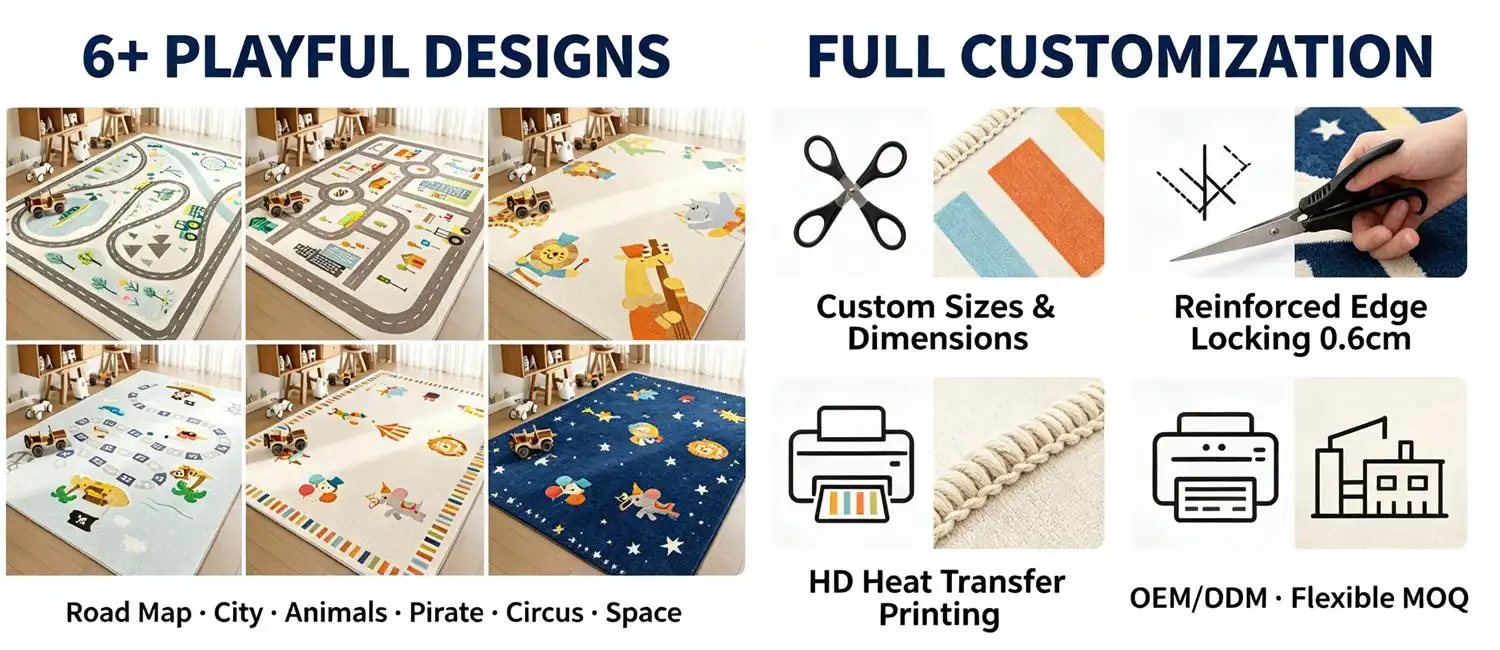
A specifically constructed children’s floor rug is different from regular carpets in three quantifiable ways. The pile is purposefully low (3mm–7mm) so that wheeled toys may roll easily without resistance. The backing is made from non-slip materials that prevent harmful movement on smooth floors. The surface prints—city road maps, grids of the alphabet, worlds of animals—transform an inert floor area into an active learning place. These design decisions are driven by real instructional goals, not commercial aesthetics.
Core Benefits Backed by Evidence
Investing in a well-constructed kids' activity rug brings tangible returns across safety, hygiene, and development:
- Impact cushioning: A 5mm crystal velvet surface with a dense 750–1100g/㎡ gram weight absorbs fall energy on hard floors, reducing bruise risk during active toddler play — consistent with flooring safety data published by the Consumer Product Safety Commission [2].
- Thermal insulation: The polyester fiber pile retains warmth at floor level, protecting young children from cold surfaces during winter months, particularly in tiled or concrete spaces.
- Acoustic dampening: Soft floor coverings reduce ambient noise by absorbing impact sound, which is measurably beneficial in classrooms and therapy settings with noise-sensitive children [3].
- Educational engagement: Printed patterns — from phonics grids to world maps — integrate seamlessly into Montessori and play-based learning frameworks, extending the Childs Play Carpet's function beyond comfort.
These four benefits collectively explain why children's play mats have moved from a "nice-to-have" accessory to a standard fixture in progressive homes, childcare centers, and pediatric therapy rooms.

How to Choose the Best Child's Play Carpet for Your Needs
Selecting the right play rug requires matching product specifications to your specific usage context. Getting this wrong at the procurement stage creates downstream quality complaints and return pressure.
Key Procurement Criteria for Buyers
The clearest starting point is defining the usage environment. Indoor residential applications prioritize softness and washability. Commercial settings — hotels, retail stores, exhibition spaces — demand durability, fire compliance, and brand customization. Here are the technical metrics that drive intelligent selection:
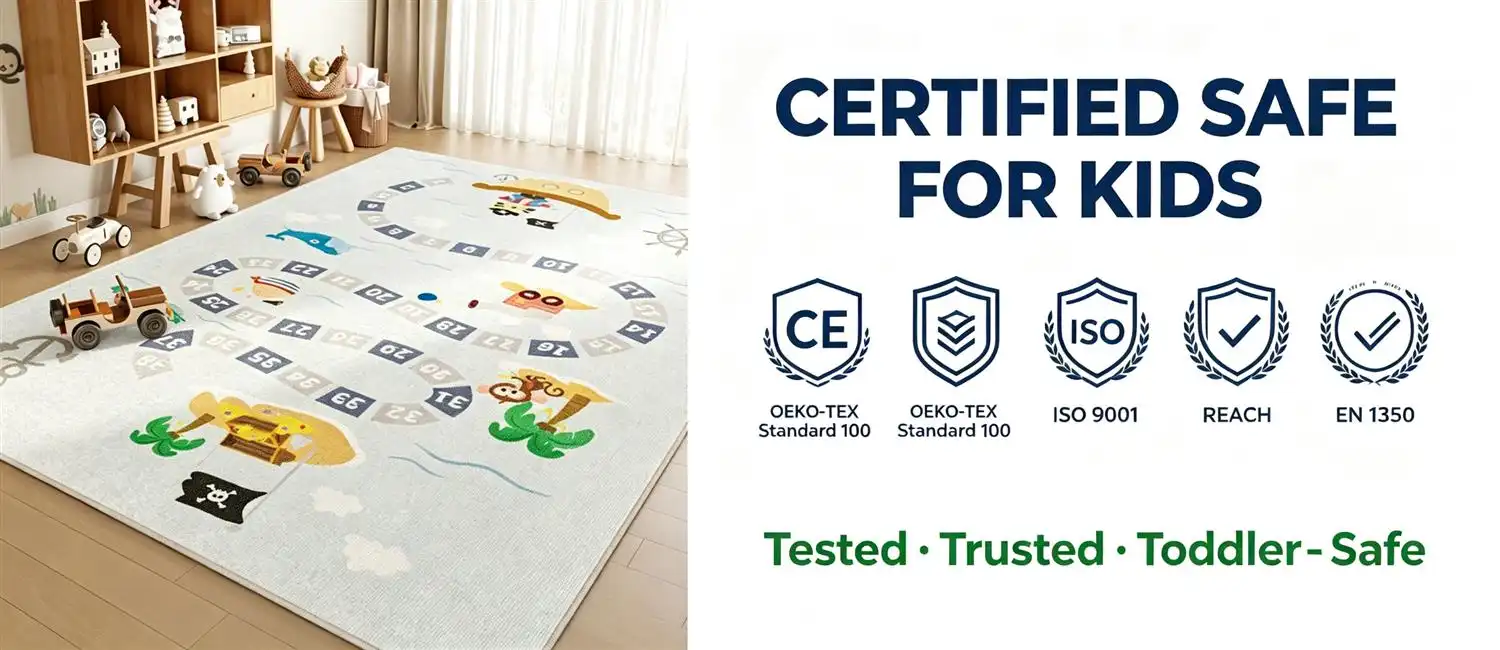
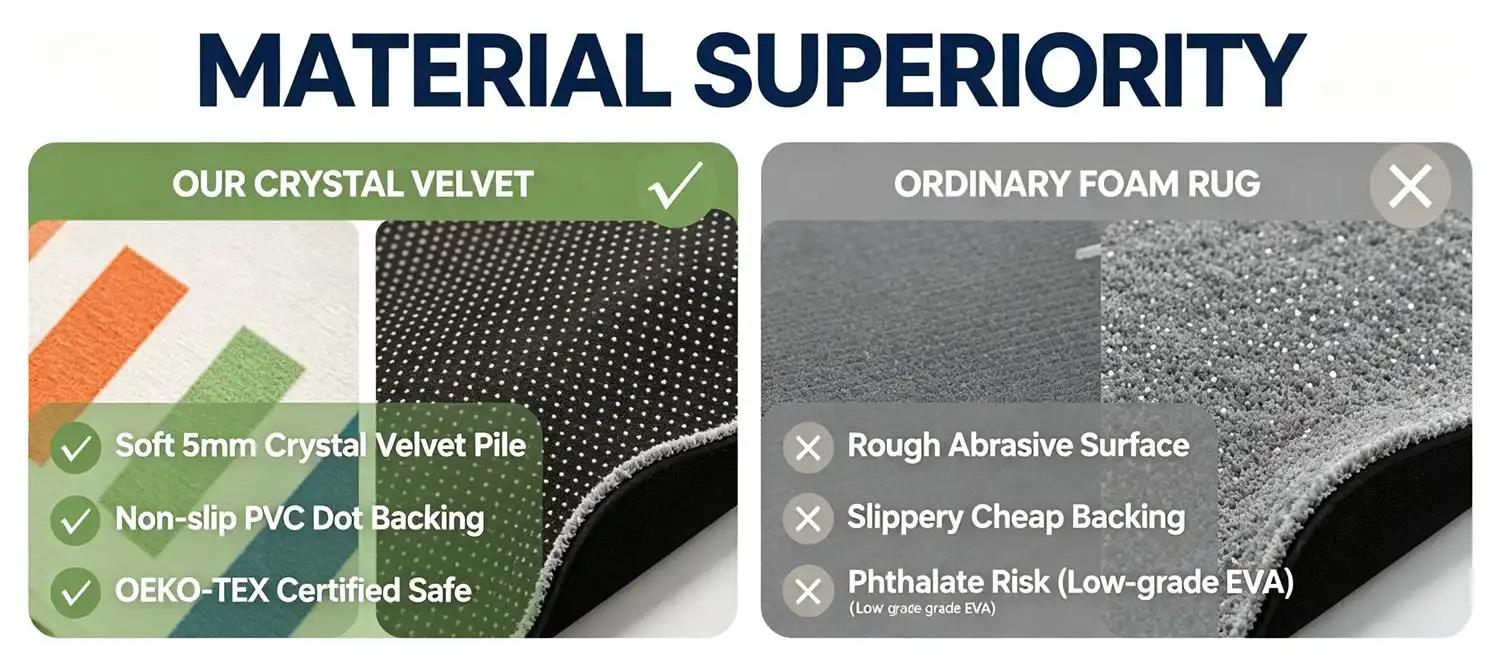
- Material safety: Polyester fiber (polyester filament) surfaces are preferable for children's environments due to their inherently low chemical migration risk. Verify OEKO-TEX Standard 100 certification to confirm the absence of harmful substances.
- Backing type: Dot plastic (PVC) backing provides reliable non-slip grip on tile, hardwood, and laminate without damaging floor finishes — a measurable advantage over foam alternatives on solvent-lacquered surfaces.
- Thickness and weight: A 5mm total thickness with 750–1100g/㎡ gram weight strikes the optimal balance between comfort and dimensional stability. The carpet lies completely flat, eliminating trip hazards near door thresholds.
- Stain resistance and maintenance: Crystal velvet surfaces with stain-resistant treatment repel spills effectively. The water-absorbent and quick-drying construction means the surface dries rapidly, preventing mold accumulation beneath the rug.
- Size flexibility: Standard sizes suit most residential applications, but B2B buyers sourcing for hotels, offices, or retail play zones consistently require custom dimensions. Confirming that a supplier supports full-size customization before placing bulk orders prevents expensive mismatches.
Supplier reliability is the other half of the procurement equation. Certifications — CE, OEKO-TEX, ISO 9001, REACH, EN 1350 — function as verifiable proxies for production consistency. A supplier holding all five signals genuine investment in compliance infrastructure, not just paper compliance.
Comparing Popular Childs Play Carpets on the Market
The children's floor covering category broadly divides into three product types: foam interlocking mats, standard textile rugs repurposed for children, and purpose-built kids' activity carpets. Each occupies a different position on the safety-durability-aesthetics spectrum.
Play Carpets vs. Foam Mats
Foam EVA mats are inexpensive and lightweight; however, they do have certain acknowledged drawbacks. Low-grade EVA foam products have been identified in many research and consumer safety evaluations as having phthalate and formamide migration problems [4]. The danger is eliminated with crystal velvet polyester carpets, which provide a textile surface meeting strict chemical safety requirements without losing any of the softness.
Durability is a similar tale. Foam mats disintegrate under intense foot traffic. They acquire crazing on their surface after 12 – 18 months in institutional use. Reinforced 0.6cm edge-locking on a high-density machine-woven polyester carpet that retains structural integrity under continuous commercial usage means a reduced total cost of ownership throughout a product lifespan.
Durable vs. Eco-Friendly Options
The market is changing. Retailers and distributors sourcing for North American and European markets indicate rising demand for eco-conscious goods from buyers in those areas. The requirement is met by Childs Play Carpets with OEKO-TEX-certified yarn and REACH-compliant colors without sacrificing performance. In procurement, the default approach to evaluating suppliers is to ask for documents and not to rely on statements.
Design also determines how quickly a home sells. While printed patterns in vibrant colors still outpace plain neutrals in residential retail channels, corporate and hospitality purchasers are always on the lookout for unique logo or branded designs for the sake of immersive environmental branding.
Best Practices for Maintaining and Using Childs Play Carpets
A well-maintained kids' floor rug retains its safety properties and aesthetic quality for years. Maintenance practices differ slightly by installation environment.
Cleaning and Installation Guidelines
The crystal velvet surface is domestic grade and does well with regular vacuuming and spot cleaning with a moist towel and light detergent. The rapid drying design means the rug is back in use within hours after washing – a substantial advantage for families with small children.
Regular professional extraction cleaning of commercial environments such as hotel kids' clubs, retail play areas, and pediatric waiting rooms improves the life of products and upholds hygiene requirements. The dot plastic backing should never be folded during storage. Roll storage in export standard roll packaging maintains the integrity of the backing and avoids permanent creasing.
The non-slip dot backing has a natural grip that is perfect for installation on smooth floors. Standard placement is adhesive-free to maintain floor finishes and for easy relocation.
Future Trends and Innovations in Children's Play Carpets
The children’s flooring sector is under three converging pressures: environmental standards, technology integration, and supply chain localization. And the lifelike instructional graphics that result from high-definition heat transfer printing are a big step forward in pattern resolution and color fidelity over standard screen printing.
An emerging category is interactive carpet designs, which include QR-linked learning material, combining physical play surfaces with digital engagement tools. Remaining on top of these trends for B2B customers helps influence forward-looking catalog selections and places product portfolios ahead of mainstream demand cycles.
Conclusion
A Childs Play Carpet is one of the most functional purchases a parent or facility manager can make. It protects children from hard floors, supports developmental play, absorbs noise, and anchors a designated safe zone within any room. The technical specifications matter: material safety, backing quality, thickness, and stain resistance collectively determine whether a product performs over time or becomes a liability. Sourcing from a certified, experienced manufacturer eliminates the quality inconsistency that erodes customer trust — and builds the foundation for a durable, profitable supply relationship.
FAQ
1. What certifications should a children's play carpet hold?
Look for CE, OEKO-TEX Standard 100, ISO 9001, REACH, and EN 1350 as baseline certifications. These collectively confirm chemical safety, flame retardancy, and production quality management. For institutional buyers, EN 71 toy safety compliance adds a further layer of assurance in markets where play carpets are classified as toy-adjacent products.
2. How does a play carpet compare to a foam mat for safety?
Crystal velvet polyester play carpets generally outperform foam mats on chemical safety and durability. Low-grade EVA foam products have documented phthalate migration risks. Textile-backed carpets with OEKO-TEX certification carry no equivalent concern and maintain structural integrity significantly longer under heavy-use conditions.
3. Can I order custom sizes and branded designs?
Yes. Reputable children's carpet manufacturers support full OEM/ODM customization — including custom sizes, logo integration, color matching, and pattern design. High-definition heat transfer technology enables precise print replication, and laser cutting accommodates irregular shapes. Flexible MOQ policies make custom orders accessible for both small pilot runs and large-volume procurement.
4. How do I maintain a children's play rug in a commercial setting?
Regular vacuuming plus periodic professional extraction cleaning maintains hygiene and surface integrity. Roll the rug for storage rather than folding to protect the dot plastic backing. Quick-drying construction minimizes downtime between cleaning sessions.
Source Your Next Childs Play Carpet Through Aijia
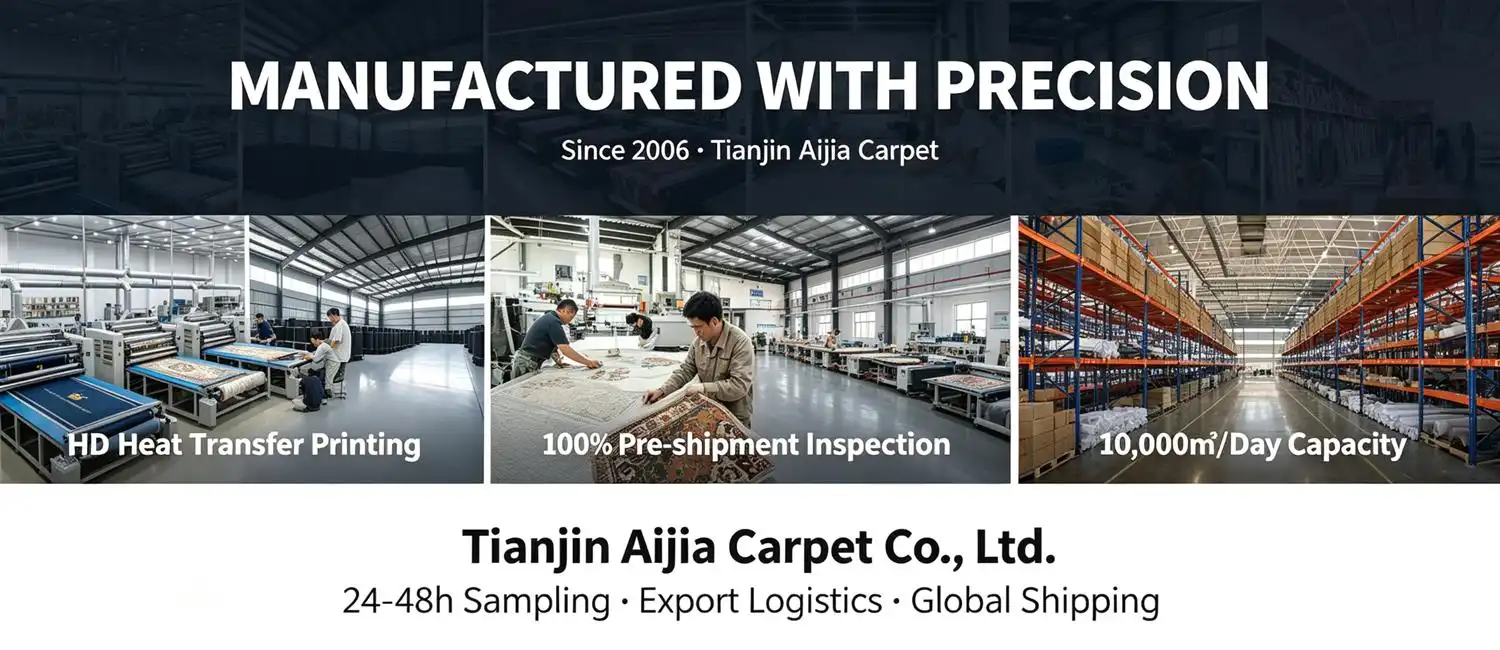
Tianjin Aijia Carpet Co., Ltd. has manufactured export-grade carpets for global markets since 2006. As a trusted Childs Play Carpet supplier, Aijia delivers CE, OEKO-TEX, ISO 9001, REACH, and EN 1350 certified products with 100% pre-shipment inspection, 24–48-hour sampling, and a 10,000㎡/day production capacity. Custom OEM/ODM orders, flexible MOQ, and full export logistics support are standard. Contact the team directly at sales@aijiarug.com to request samples and bulk pricing.
References
1. American Academy of Pediatrics. (2018). The Importance of Play in Promoting Healthy Child Development. Pediatrics. https://publications.aap.org/pediatrics/article/119/1/182/70699/The-Importance-of-Play-in-Promoting-Healthy-Child
2. U.S. Consumer Product Safety Commission. (2021). Home Safety Fact Sheet: Floor and Surface Hazards. https://www.cpsc.gov/Safety-Education/Safety-Education-Centers/Kids-Safety
3. National Institute for Occupational Safety and Health (NIOSH). (2020). Noise and Children's Learning Environments. CDC. https://www.cdc.gov/niosh/topics/noise/default.html
4. European Chemicals Agency (ECHA). (2022). REACH Restriction on Phthalates in Articles. https://echa.europa.eu/substances-restricted-under-reach
5. OEKO-TEX Association. (2023). OEKO-TEX Standard 100: What It Means for Textile Safety. https://www.oeko-tex.com/en/our-standards/oeko-tex-standard-100
6. The Flooring Industry Council. (2022). Children's Flooring Safety and Material Standards Report. Floor Covering Weekly. https://www.floorcoveringweekly.com/main/research/childrens-flooring-safety-standards
Request fast quotes for bulk carpets, OEM & ODM floor mats, supported by strict quality control and complete supply chain.