- English
- French
- German
- Portuguese
- Spanish
- Russian
- Japanese
- Korean
- Arabic
- Greek
- German
- Turkish
- Italian
- Danish
- Romanian
- Indonesian
- Czech
- Afrikaans
- Swedish
- Polish
- Basque
- Catalan
- Esperanto
- Hindi
- Lao
- Albanian
- Amharic
- Armenian
- Azerbaijani
- Belarusian
- Bengali
- Bosnian
- Bulgarian
- Cebuano
- Chichewa
- Corsican
- Croatian
- Dutch
- Estonian
- Filipino
- Finnish
- Frisian
- Galician
- Georgian
- Gujarati
- Haitian
- Hausa
- Hawaiian
- Hebrew
- Hmong
- Hungarian
- Icelandic
- Igbo
- Javanese
- Kannada
- Kazakh
- Khmer
- Kurdish
- Kyrgyz
- Latin
- Latvian
- Lithuanian
- Luxembou..
- Macedonian
- Malagasy
- Malay
- Malayalam
- Maltese
- Maori
- Marathi
- Mongolian
- Burmese
- Nepali
- Norwegian
- Pashto
- Persian
- Punjabi
- Serbian
- Sesotho
- Sinhala
- Slovak
- Slovenian
- Somali
- Samoan
- Scots Gaelic
- Shona
- Sindhi
- Sundanese
- Swahili
- Tajik
- Tamil
- Telugu
- Thai
- Ukrainian
- Urdu
- Uzbek
- Vietnamese
- Welsh
- Xhosa
- Yiddish
- Yoruba
- Zulu
Modern Anti-Scratch: Aesthetic Design for Any Home Style
Walking into a home where floors stay pristine season after season isn't just luck—it's a deliberate choice rooted in smart flooring protection with Jute Indoor Door Mat. Modern anti-scratch entryway solutions, especially those using imitation sisal materials, often referred to as jute-style indoor doormats, combine performance with visual appeal. These mats protect hardwood, laminate, and tile from daily wear while complementing contemporary, minimalist, and even industrial interior styles. For distributors and import businesses evaluating floor protection products, this blend of durability and design flexibility translates into higher margins and fewer customer complaints. The shift toward scratch-resistant entrance mats stems from increasing flooring replacement costs and rising consumer awareness around home maintenance. Unlike traditional fiber mats that shed, snag, or lose shape, today's engineered alternatives deliver consistent performance across residential, commercial, and hospitality applications.
Understanding Modern Anti-Scratch Materials and Their Benefits
What Makes Imitation Sisal Superior
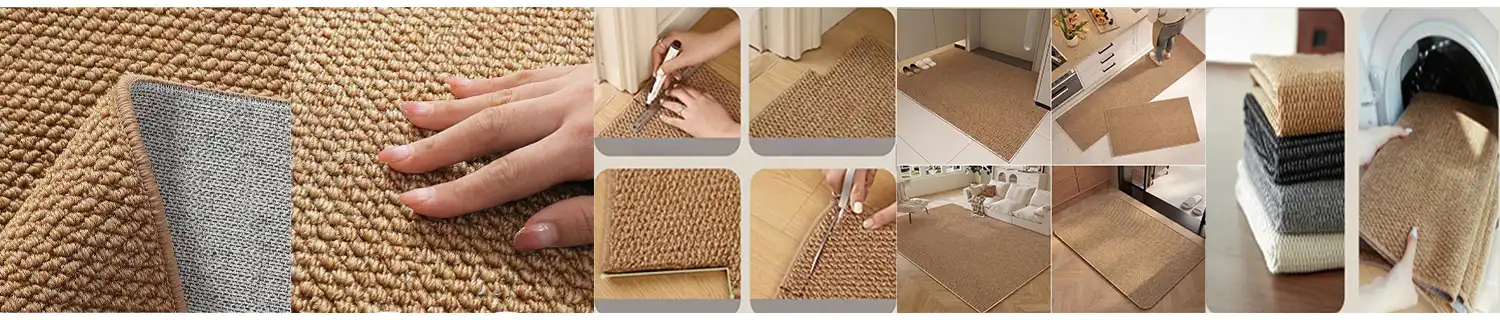
People have liked the rustic look of natural jute and sisal fibers for a long time, but they are hard to make sure are of uniform quality and sturdiness. Imitation sisal made from high-density polyester fiber gets around these problems without losing its realistic look. The synthetic material doesn't absorb water, so it doesn't get mildewy or smelly as some organic fiber mats do. With a weight of 1000 grams per square meter, these mats can handle a lot of foot traffic while still being light enough to move around easily during cleaning cycles.
Sisal alternatives made from polyester also don't lose their color when they're in indirect sunlight near glass front doors, which is a common problem with fibers made from plants. The high-density machine weaving process makes a smooth surface that traps dirt below the contact zone. This keeps the dirt from scratching the floor below when people walk on it.
Anti-Scratch Technology in TPR Backing Systems
What the mat's back is made of decides whether it saves floors or damages them. Because it is more chemically stable and has a better grip coefficient, thermoplastic rubber (TPR) works better than latex and PVC options. TPR stays flexible at all temperatures and doesn't give off plasticizers that stain vinyl floors or leave sticky film on hardwood floors. After being washed many times in a washing machine at temperatures up to 60°C, the removable base still doesn't slip after dozens of rounds.
Because they are only one centimeter thick, these mats can fit under doors with little space between them while still providing enough padding. The 0.6-centimeter edge-locking width keeps corners from curling up, which gets rid of trip risks in business settings where legal concerns drive purchasing choices.
Waterproof Performance for Multi-Season Use
These mats have waterproof finishes on the outside so they can handle wet shoes without getting the core material wet. During rainy or snowy months, water stays on the surface of the mat and either evaporates on its own or is wiped off when the mat is cleaned regularly. This keeps water from pooling on floors nearby, which cuts down on slip-and-fall accidents that, according to the National Safety Council, cost U.S. businesses more than $70 billion a year. The finish is stain-resistant, so coffee spills, pet accidents, and tracked-in mud won't change the color permanently. The product will look good for a long time.
Design Principles That Complement Any Interior Style
Solid Color Versatility Across Decor Themes
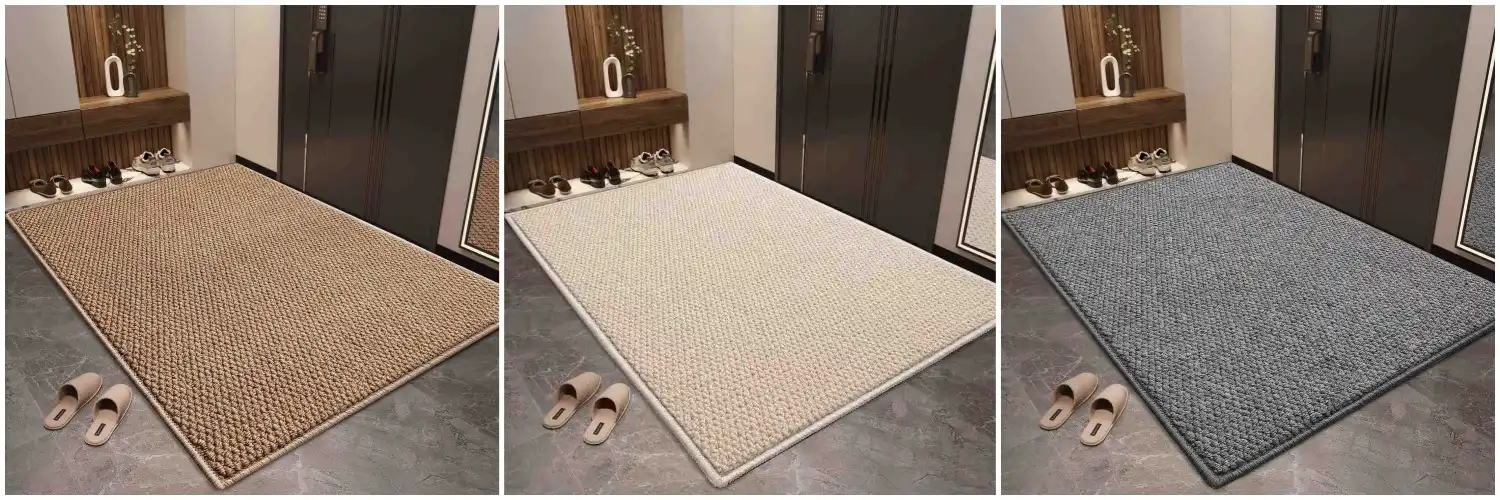
Charcoal, taupe, navy, and slate are all solid colors in neutral tones that go well with both warm and cool color schemes forthe Jute Door Mat for Indoor Use. This range of color options is important when shopping for retail chains with strict brand rules about color matching. Instead of printed mats that look bad with busy floors or clash with architectural features, solid-colored fake sisal adds a grounding element that draws attention to entryway design instead of taking it over.
When trying to keep all of their properties with different interior themes the same, hotel chains like this flexibility. One SKU can serve modern boutique hotels, traditional business lodges, and modernist urban locations. This makes managing inventory easier and lowers the cost per unit by allowing for bulk purchases.
Texture as a Design Element
Imitation sisal's woven texture makes flat, smooth surfaces more interesting to touch in modern buildings. The ribbed surface makes soft shadow lines that move throughout the day as the sun's angle changes. This gives entryways that would otherwise be flat more visual depth. This difference in texture works especially well in simple rooms with few decorations, making the mat work as both safety gear and a design element.
Architects who choose the materials for commercial office buildings are becoming more aware that entrance mats are part of the building's visual language and not just a functional necessity. The polished look of high-density weave surfaces shows care for detail, which strengthens brand identity right away when people walk into a room.
Maintenance Practices That Extend Product Lifespan
Daily and Weekly Cleaning Protocols
Regular vacuuming with a brush attachment gets rid of dirt and dust on the surface before it gets deep into the weave. This should be done at the end of the day and in the middle of the shift for commercial installations that get 500 or more foot impressions per day. Shaking the mat once a week releases particles that are stuck below the surface, restoring its ability to catch dirt.
The washable TPR base can be completely submerged and cleaned every 4 to 6 weeks, based on how much traffic there is. Putting clothes through a washing machine with cold or warm water and a mild soap gets rid of oils and small particles that cleaning doesn't pick up. Most mats can be used again within 24 hours after being dried in the air on a flat surface.
Addressing Common Wear Patterns
Over time, wear tracks become obvious in areas that get a lot of use right in front of door swings. By turning the mat 180 degrees every three months, you spread the stress over the whole area, which makes it last twice as long. Even though edge fraying is rare when the construction is done right, it can be fixed with sharp scissors without damaging the structure.
In the winter, deicing salts can leave stains. To get rid of them, use a soft brush to apply a vinegar-water solution and then rinse the area well. Natural fibers weaken when they come into contact with acidic or alkaline compounds, but polyester fibers don't break down when cleaned with common cleaners because they are chemically resistant.
Procurement Considerations for Business Buyers
Evaluating Customization Capabilities
Bulk buyers need options when it comes to sizes, branding, and order quantities. OEM and ODM manufacturers can make mats that exactly fit the needs of an architect, from large 2x4 meter lobby runners to small 40x60 centimeter side-entrance mats. Customizing logos through heat transfer printing lets businesses put their names on the doors to buildings, which helps with branding and keeps the floors from slipping andlastsg a long time.
Minimum order amounts have a big effect on how much each unit costs for wholesalers. Suppliers with variable MOQs can handle both trial orders for new product lines and full container loads for routes of distribution that are already set up. When working on business projects that need to be done quickly, production capacity is important. Manufacturers who can make 10,000 square meters of flooring every day can meet tight installation plans without sacrificing quality.
Certification and Compliance Standards
International buyers should make sure that Jute Indoor Door Mat goods meet local safety and environmental standards. When something has a CE mark on it, it means that it meets European safety, health, and environmental protection laws. The OEKO-TEX Standard 100 approval proves that there are no harmful substances, meeting the rising demand for home goods that are safe for people. ISO 9001 certification shows that quality management processes are consistent, which lowers variation from batch to batch, making managing inventory harder.
EN 13501 fire classification ratings make sure that mats meet the standards for flame spread in public areas for business projects. REACH compliance makes sure that banned chemicals stay below the levels that are allowed when they are sold in the European Union. These licenses aren't just necessary for compliance's sake; they lower risks and protect buyers' identities and end users' safety.
Logistics and Packaging Optimization
When sending goods across international borders, export-standard roll packing keeps dimensional weight charges to a minimum. This is a key cost factor when freight rates change. Putting goods in cartons with moisture barriers keeps them safe while they travel across humid ocean routes. When shipped overseas, woven bag packaging is tear-resistant for rough-handling settings.
Optimizing how containers are loaded has a big effect on the total landed costs. Manufacturers who figure out exact stacking patterns get the most out of each cube, which lowers the amount of freight that needs to be allocated per unit. A well-thought-out packing plan can boost the efficiency of containers by 15 to 20 percent, which directly increases margins for both producers and distributors.
Why Aijia Stands Out Among Manufacturers
Two Decades of Production Expertise
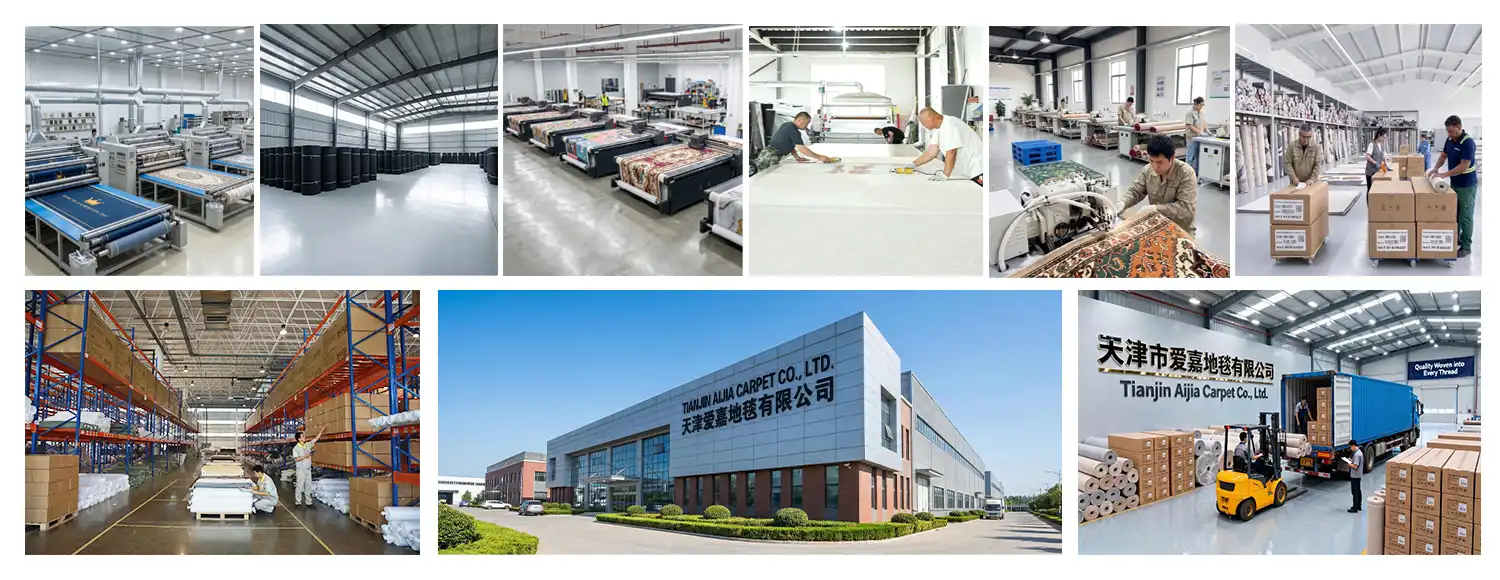
Every order comes from Tianjin Aijia Carpet Co., Ltd., which has been making specialty carpets for twenty years. The building is in Cuihuangkou Town, which is the center of China's carpet industry. It has one management structure for study, design, production, and export. This vertical integration cuts down on the delays and inconsistent quality that come with supply chains that use more than one vendor.
The company can make 10,000 square meters of goods every day, which lets them fill orders quickly without losing the quality of their inspections. Orders smaller than 2,000 square meters are usually shipped within seven days. This is so that general contractors and project managers can meet the tight deadlines that are often required by penalty clause contracts.
Quality Assurance Through Comprehensive Inspection
Aijia uses strict pre-shipment inspection procedures to check every square meter for problems with the weaving, differences in color, and errors in the measurements. This gets rid of the expensive shocks that happen when container loads come in with goods that can't be used because of quality problems. The company has an ISO 9001-certified quality control system that keeps track of every step of the process, from inspecting the raw materials as they come in to packing them at the end.
Heat transfer and laser cutting technologies make it possible to customize things precisely while keeping production speeds high. Pattern replication happens exactly the same way in approved samples as it does in mass production. This means that there are no "sample looks great, but bulk order disappoints" situations that hurt relationships between buyers and sellers.

Complete Compliance Documentation
Aijia has certificates for CE, OEKO-TEX, REACH, and EN 1350. This gives them all the paperwork they need to easily clear customs at ports in North America and Europe. The company's export documentation team makes commercial invoices, packing lists, certificates of origin, and inspection reports that meet all import rules, even the strictest ones.
The commitment after the sale goes beyond delivery; dedicated liaison people are assigned to customers who buy from the company again and again. If there are problems with the quality, the company will repair or fix it right away at its own cost, which includes the cost of shipping the item back to the factory. This is a guarantee that shifts the risk from the buyers to the maker, who is in charge of production.
Conclusion
Modern anti-scratch doormats like Jute Indoor Door Mat solve the problem of protecting floors from scratches while also meeting modern style standards. When you combine the TPR washable backing, waterproof surface treatment, and high-density polyester weaving, you get performance that makes the purchase worth it in home, business, and hospitality settings. When supplier dependability, customization options, and compliance paperwork are taken into account along with product specs when sourcing choices are made, long-term cost efficiency goes up, and customer service workloads go down.
Frequently Asked Questions
1. How often should these mats be cleaned to maintain anti-scratch effectiveness?
By cleaning every day, you get rid of the rough bits that would otherwise scratch floors when you walk on them. Regular vacuuming doesn't get rid of the embedded oils and fine grit that build up, but machine washing every 4 to 6 weeks does. The TPR base can be washed many times without losing its grip.
2. Can these mats accommodate custom branding for retail chain rollouts?
Using heat transfer printing to add logos, writing, and images to a mat doesn't hurt its structure or make it easier to clean. Manufacturers that offer OEM services can match corporate color specifications and make sure that branding is consistent across orders from different locations. Custom printing has different minimum quantities, but well-known suppliers will often let you do smaller test runs before committing to full-scale orders.
3. Do imitation sisal mats offer environmental advantages over synthetic alternatives?
Natural fiber options, which need farming inputs, pesticides, and a lot of water to make, produce more trash than polyester fiber mats. The longer lifespan means that the product doesn't need to be replaced as often, which is better for the earth over its whole existence. When a polyester product's useful life is over, it can be recycled in ways that natural fibers that have been contaminated can't.
Partner With Aijia for Your Entrance Mat Requirements
Aijia is an expert at making scratch-resistant entrance solutions that meet the high standards of commercial project buyers, international distributors, and e-commerce brands. Our fake sisal mats look good and last a long time. They have been certified by many organizations, such as CE, OEKO-TEX, and ISO 9001. Our flexible MOQ policies and seven-day delivery for standard orders allow for both trial purchases and container-load commitments, whether you need standard inventory items or fully customized OEM products with your brand on them. Email our export team at sales@aijiarug.com to talk about your specific needs and get samples that show how high our quality standards are. As a well-known Jute Indoor Door Mat seller with 20 years of experience, we know the pressures buyers are under to make purchases today, so we've built our services to meet those needs.
References
1. Thompson, M. (2021). Floor Protection Strategies in Commercial Real Estate. Facilities Management Journal Press.
2. Chen, L., & Rodriguez, P. (2022). Synthetic Fiber Technologies in Textile Manufacturing. International Textile Research Quarterly, 47(3), 112-128.
3. National Safety Council. (2023). Workplace Injury Cost Analysis: Slip and Fall Prevention. NSC Statistical Reports.
4. Harrison, J. (2020). Material Selection for High-Traffic Environments. Architectural Specifications Handbook, 8th Edition.
5. Williams, K. (2022). Sustainable Procurement in the Hospitality Sector. Green Building Materials Review, 15(2), 203-219.
6. European Committee for Standardization. (2021). Fire Classification Standards for Floor Coverings: EN 13501 Compliance Guide. CEN Technical Documentation.
Request fast quotes for bulk carpets, OEM & ODM floor mats, supported by strict quality control and complete supply chain.