- English
- French
- German
- Portuguese
- Spanish
- Russian
- Japanese
- Korean
- Arabic
- Greek
- German
- Turkish
- Italian
- Danish
- Romanian
- Indonesian
- Czech
- Afrikaans
- Swedish
- Polish
- Basque
- Catalan
- Esperanto
- Hindi
- Lao
- Albanian
- Amharic
- Armenian
- Azerbaijani
- Belarusian
- Bengali
- Bosnian
- Bulgarian
- Cebuano
- Chichewa
- Corsican
- Croatian
- Dutch
- Estonian
- Filipino
- Finnish
- Frisian
- Galician
- Georgian
- Gujarati
- Haitian
- Hausa
- Hawaiian
- Hebrew
- Hmong
- Hungarian
- Icelandic
- Igbo
- Javanese
- Kannada
- Kazakh
- Khmer
- Kurdish
- Kyrgyz
- Latin
- Latvian
- Lithuanian
- Luxembou..
- Macedonian
- Malagasy
- Malay
- Malayalam
- Maltese
- Maori
- Marathi
- Mongolian
- Burmese
- Nepali
- Norwegian
- Pashto
- Persian
- Punjabi
- Serbian
- Sesotho
- Sinhala
- Slovak
- Slovenian
- Somali
- Samoan
- Scots Gaelic
- Shona
- Sindhi
- Sundanese
- Swahili
- Tajik
- Tamil
- Telugu
- Thai
- Ukrainian
- Urdu
- Uzbek
- Vietnamese
- Welsh
- Xhosa
- Yiddish
- Yoruba
- Zulu
What Makes a Good Entrance Thick Front Door Mat?
A good thick front door mat delivers more than aesthetics — it functions as a frontline barrier against dirt, moisture, and safety hazards. The best entrance mats combine appropriate pile density, reliable anti-slip backing, dimensional stability, and durable surface materials that hold up under daily foot traffic. Whether deployed at a hotel lobby, retail shopfront, or home entryway, a quality thick front door mat must trap debris efficiently, resist wear, and maintain its shape over time. Understanding these defining characteristics helps procurement managers and distributors make smarter sourcing decisions that protect both floors and budgets.
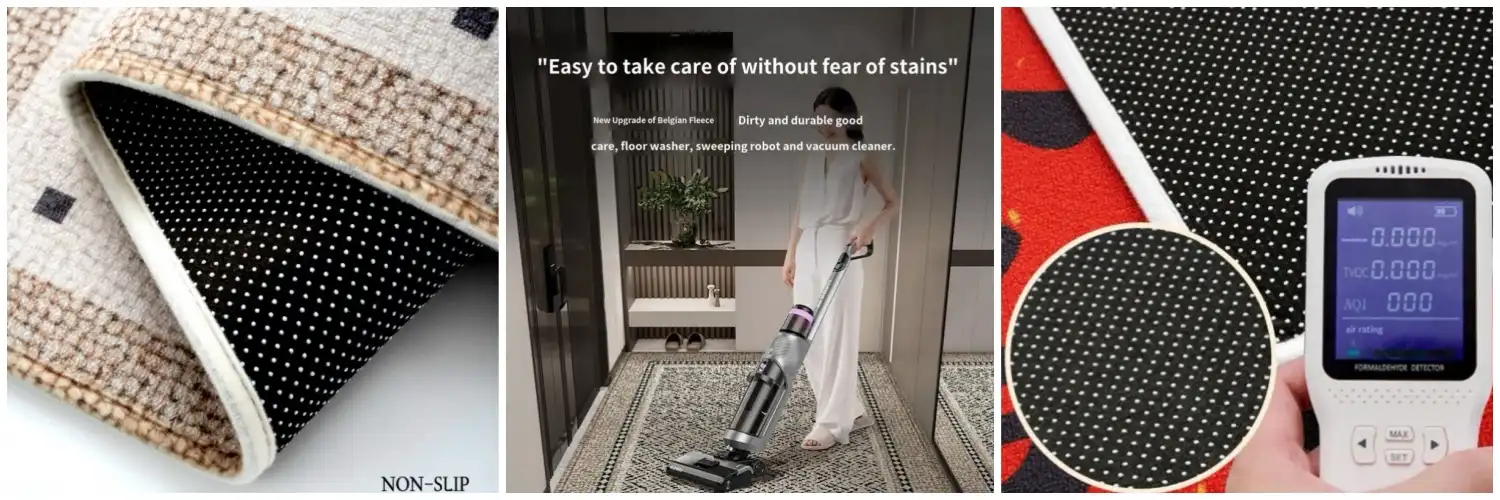
Understanding Thick Front Door Mats: Key Features and Benefits
Entrance mats serve a precise functional role in any built environment. The National Floor Safety Institute says that walk-off matting systems can collect up to 80% of entering dirt and moisture within the first six to fifteen feet of an entrance. This number has a direct effect on how much it costs to clean the building and how long the floors last.
Core Functional Benefits Worth Knowing
Here are the primary performance advantages that distinguish a high-quality entrance mat from a generic floor covering:
- Superior debris and moisture capture: High-density loop pile construction, like a 900 g/m² polyester surface, traps fine particles and absorbs moisture before they move deeper into a facility. This means that the interior floors last longer and don't need to be cleaned as often.
- Anti-slip safety performance: A dot PVC backing gives a stable grip on hard floors, lowering the risk of slip-and-fall accidents that are a big problem in business settings.
- Sound and thermal insulation: Dense looped pile fibres act as a barrier against cold floors in the winter, keeping entryways warmer and lowering background noise, which makes hotel lobbies and corporate offices much more comfortable.
- Dimensional stability under sustained use: Polyester fibre doesn't shrink or deform easily, so the mat stays flat in a variety of room layouts without ends curling up and becoming trip risks.
These advantages collectively justify the procurement investment in entrance matting, particularly for high-traffic commercial projects where replacement costs add up quickly.
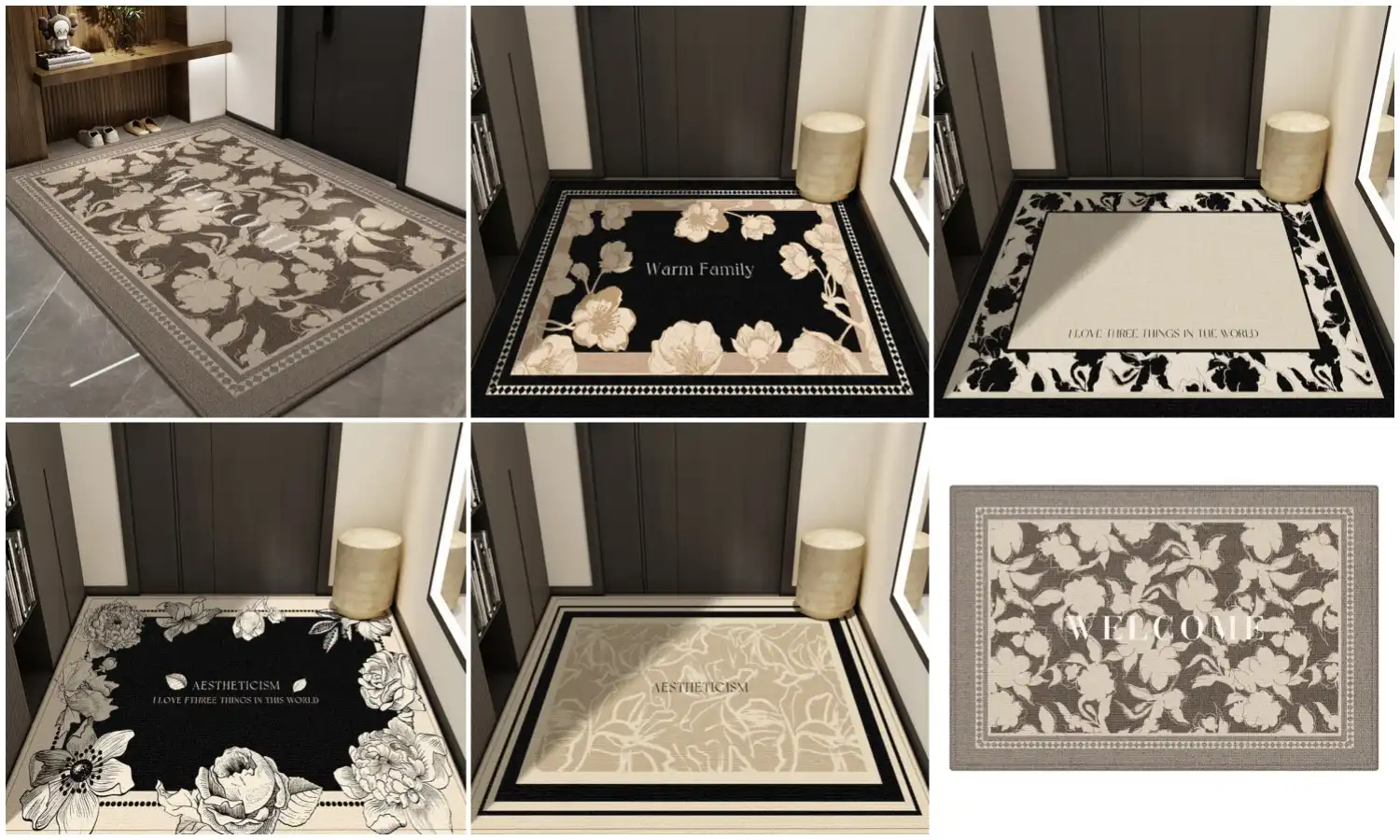
Comparing Thick Front Door Mats: Material and Design Choices for Procurement
The choice of material affects how well an entry mat works in different settings. The table below shows how popular mat materials stack up against some important buying criteria:
| Material | Durability | Moisture Resistance | Maintenance Ease | Best Application |
|---|---|---|---|---|
| Polyester Loop Pile | High | Moderate–High | Easy | Indoor/semi-outdoor business |
| Coir | Moderate | Low | Moderate | Outdoors, traditional looks |
| Rubber | Very High | Very High | Easy | Outside in wet or industrial areas |
| Nylon | High | Moderate | Moderate | Heavy-traffic indoor |
Polyester loop pile mats are a good compromise between nylon and other options because they offer similar wear resistance at a lower cost per unit, and a thick front door mat with a stain-resistant surface can make maintenance easier for facility managers. On the other hand, natural coir mats break down more quickly when they get wet, which makes them less useful for year-round outdoor use in North America.
Design Versatility Matters for B2B Buyers
Distributors and retail brands decide what to buy based on more than just the material. Design flexibility is also important. A mat that comes in plain colors, printed patterns, and fully custom designs that can include a name gives wholesale sellers a lot more ways to differentiate their brands and make their products stand out. When you print a lot of mats with high-definition heat transfer printing, the colors stay true, which is very important for OEM and private label programs.

How to Choose the Right Thick Front Door Mat: A B2B Procurement Guide?
When buying managers look at entrance mats in bulk, they need an organized framework that goes beyond how the mats look on the surface. Almost every specification that is worth looking at is affected by the operating context.
The table below maps application environments to key mat specifications:
| Application Environment | Recommended Thickness | Priority Feature | Suggested Backing |
|---|---|---|---|
| Hotel Lobby | 6mm+ | Custom logos and soundproofing | Dot PVC |
| Office Building | 6mm | Low image, doesn't stain | Dot PVC |
| Retail Store | 6mm | The design looks good and is easy to clean | Dot PVC |
| Exhibition/Event | 6mm | Custom print and quick deployment | Dot PVC |
| Home Entryway | 6mm | Comfort and stable measurements | Dot PVC |
A total thickness of 6 mm is a good standard for business entrance mats. It's light enough that it won't get caught under door sweeps but thick enough to provide good cushioning and catch waste. The edge-locking finish keeps the product from tearing even after heavy use, so you don't have to replace it too soon.
What Must Bulk Buyers Verify Before Placing Orders?
When purchasing a thick front door mat, the seller should make sure that the following details are met:
- Pile height
- Gram weight shows the real mass, not just the physical size.
- Backing integrity
- MOQ versatility is important for wholesalers who handle many SKUs.
- Production capacity
Maintaining and Optimizing the Performance of Thick Front Door Mats
For as long as they are used, entrance mats will look good and work well as long as they are properly maintained. Polyester loop pile mats are very low-maintenance. The tight cluster structure keeps dirt from getting trapped, and the surface can be cleaned with a vacuum or a light rinse without any special tools.
Seasonal and High-Traffic Maintenance Practices
In wet seasons or places with a lot of foot traffic, mats with a stain-resistant surface treatment and fast-drying pile design stay less slippery longer than mats that haven't been treated. To figure out when to change things before safety performance goes down, procurement teams that are in charge of facilities in more than one place should set up regular inspection rounds that check the integrity of the edges, the adhesion of the backing, and the compression of the piles. Taking care of a slip-and-fall accident or fixing ruined indoor flooring is much more expensive than replacing a worn mat before it happens.
Procurement Transaction Tips: How to Buy Thick Front Door Mats Efficiently?
When buying a lot of entrance mats, you have to find a balance between price, lead time, and supplier reliability. Online B2B sites make it easier to find suppliers, but you have to talk to makers directly to make sure they can produce what you want and that the quality is consistent.
Key procurement efficiency practices include asking for samples before committing to buy in bulk, making sure you know the export packaging standards, and setting clear delivery dates that are tied to production capacity. Suppliers with export experience and recorded quality control methods, such as 100% pre-shipment inspection, lower the risk of getting goods that don't meet standards, which can lead to expensive returns or market delays.
Volume discount negotiations are most effective when buyers can commit to buying every three months. This lets suppliers see how production is planned and lets buyers get better unit prices without sacrificing delivery reliability.
Conclusion
A well-chosen doormat saves floors, lowers safety risks, and improves the way a brand looks in both business and home settings. Every specification has an effect on the procurement process, from the choice of material and pile density to the type of backing and maintenance needs, especially when selecting a thick front door mat for high-traffic entrances. Polyester loop pile mats that are 6 mm thick and 900 g/m² in weight are a tried-and-true, low-cost standard for B2B buyers who want durability and design flexibility for a wide range of uses. Distributors, retail brands, and buyers of commercial projects that invest in reliable sourcing partnerships always do better than those that only look at unit price.
FAQ
1. What thickness is ideal for a commercial entrance mat?
For commercial entryways, the total thickness should be at least 6 mm. This gives enough support and collects enough garbage while still being small enough to fit through most doorways without getting in the way. Places with a lot of foot traffic need thicker pile building instead of just more thickness.
2. Is a 900 g/m² weight sufficient for high-traffic settings?
Yes. A gram weight of 900 g/m² means that the pile structure is really thick and can handle heavy foot traffic in places like hotels, offices, and stores. The durability and soil-holding capacity of a mat are directly related to its gram weight. Lighter mats compress and mat down more quickly when they are loaded.
3. How often should commercial entrance mats be cleaned?
Daily vacuuming or shaking is good for high-traffic entryways, and once a week, a deeper clean is best. Surface cleaning once a week and deep maintenance once a month can keep low-traffic areas running smoothly. Compared to natural fiber options, polyester loop pile construction makes this process a lot easier.
4. Can entrance mats be customized with logos or brand colors?
Of course. With OEM and ODM production choices, retailers and wholesalers can choose their own colors, patterns, logo placement, and sizes that aren't standard. Heat transfer printing technology can produce high-definition prints in large quantities while keeping the colors true.
Partner With Aijia for Your Next Thick Front Door Mat Order
Since 2006, Aijia has been making export-quality entrance mats. They can make 10,000 m² of them every day and check every order carefully before sending it out. Aijia is a verified maker of thick front door mat products that sells to wholesalers in North America and around the world. They offer OEM/ODM customization, a flexible MOQ for large orders, and full compliance paperwork for CE, OEKO-TEX, ISO 9001, and REACH. You can email the team at sales@aijiarug.com to get prices and samples.
References
1. National Floor Safety Institute (NFSI) — Standard for the Measurement of Walkway Slip Resistance, 2022.
2. ASTM International — ASTM F1637: Standard Practice for Safe Walking Surfaces, 2023.
3. OEKO-TEX Association — OEKO-TEX Standard 100: Testing for Harmful Substances in Textiles, 2023.
4. International Organization for Standardization — ISO 9001: Quality Management Systems — Requirements, 2015.
5. European Committee for Standardization — EN 13501-1: Fire Classification of Construction Products and Building Elements, 2019.
6. Facility Cleaning Decisions Magazine — The Business Case for Entrance Matting Systems, 2021.
Request fast quotes for bulk carpets, OEM & ODM floor mats, supported by strict quality control and complete supply chain.