- English
- French
- German
- Portuguese
- Spanish
- Russian
- Japanese
- Korean
- Arabic
- Greek
- German
- Turkish
- Italian
- Danish
- Romanian
- Indonesian
- Czech
- Afrikaans
- Swedish
- Polish
- Basque
- Catalan
- Esperanto
- Hindi
- Lao
- Albanian
- Amharic
- Armenian
- Azerbaijani
- Belarusian
- Bengali
- Bosnian
- Bulgarian
- Cebuano
- Chichewa
- Corsican
- Croatian
- Dutch
- Estonian
- Filipino
- Finnish
- Frisian
- Galician
- Georgian
- Gujarati
- Haitian
- Hausa
- Hawaiian
- Hebrew
- Hmong
- Hungarian
- Icelandic
- Igbo
- Javanese
- Kannada
- Kazakh
- Khmer
- Kurdish
- Kyrgyz
- Latin
- Latvian
- Lithuanian
- Luxembou..
- Macedonian
- Malagasy
- Malay
- Malayalam
- Maltese
- Maori
- Marathi
- Mongolian
- Burmese
- Nepali
- Norwegian
- Pashto
- Persian
- Punjabi
- Serbian
- Sesotho
- Sinhala
- Slovak
- Slovenian
- Somali
- Samoan
- Scots Gaelic
- Shona
- Sindhi
- Sundanese
- Swahili
- Tajik
- Tamil
- Telugu
- Thai
- Ukrainian
- Urdu
- Uzbek
- Vietnamese
- Welsh
- Xhosa
- Yiddish
- Yoruba
- Zulu
Why Every Home Chef Needs a Slip Resistant Mats Kitchen?
Everyone has a story about their kitchen. They remember family dinners, late-night snacks, and coffee in the morning. But a lot of home cooks don't see the danger in these good times. People often trip and fall in the kitchen, so Slip Resistant Mats Kitchens can help keep you safe. These special floor covers make the areas around sinks, stoves, and prep areas safer to work in because they don't slip and can keep moisture in check. Buying good slip-resistant kitchen mats isn't just for comfort if you're a serious home cook who spends hours practising recipes or the boss of a busy home kitchen. It's also to keep you from getting hurt, which can ruin your cooking hobby and your daily life.
Understanding Slip-Resistant Kitchen Mats: What They Are and Why They Matter
It's not enough to know how to use tools and handle food properly to be safe in the kitchen. It is said by the National Safety Council that falls are the cause of many accidents that happen at home. Because of the oil, water, and food that can splash around, kitchens are one of the most dangerous places. You can avoid these dangers by putting down slip-resistant mats in kitchens. These mats are made in a special way to grip both the floor and your shoes.
The Engineering Behind Effective Kitchen Safety Mats
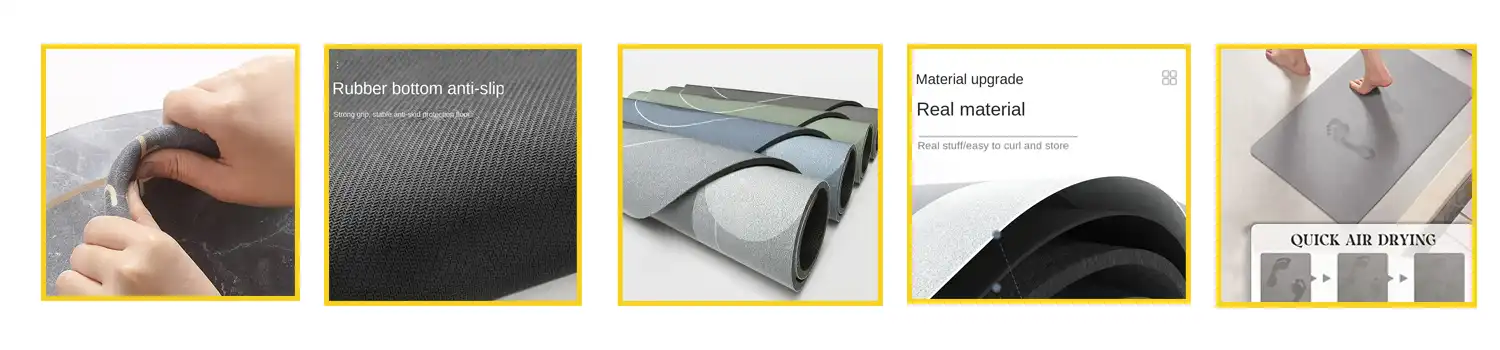
New Slip-Resistant Mats Kitchen products don't slip and are made with several layers that are meant to work in real kitchens. Most of the time, the top layer is made of rough rubber or strong tech silk that doesn't slip when it gets wet. The next layer is a support layer in the middle, which is generally foamed rubber. This keeps the structure strong and makes standing for long periods of time more comfortable. The inside layer is made of rubber, and the bottom layer has grip patterns that keep the mat in place on tile, hardwood, or concrete floors.
Good mats are between 2.5 mm and 3 mm thick and are carefully weighted, with 1600 g per square meter being the average. This keeps them steady without making the sides easy to trip over. Because they were cut with a laser, the sides are smooth and rounded, so they lie flat on the floor. This is better than the cheaper ones that curl up at the ends.
Common Kitchen Hazards That Demand Protection
Water that builds up near sinks makes rinks that you can't see on floors that are smooth. A few feet away from the stovetops, cooking oil spills out and makes the ground slippery. Things like fridge condensation, dropped ice cubes, and washing veggies can all make things wet. These everyday items can make cooking dangerous, especially if you're moving hot pots, knives, or plates that are easy to break.
These risks have been known to professional kitchens for a long time. That's why restaurants and food service facilities still use commercial-grade slip-resistant mats in kitchens. People who are older, have kids, or have trouble moving around are more likely to get hurt at home, so follow the same rules.
Key Benefits of Using Slip-Resistant Mats in the Kitchen
Good slip-resistant mats: kitchens are useful for more than just keeping mistakes from happening. Some of these perks are relaxation, cleanliness, and lower costs in the long run.
Enhanced Safety Through Advanced Surface Technology
The main goal of mats today is still to keep people from falling, but they do this with better materials than just a rough surface. These tech silk surfaces don't stain and are easy to clean. They also keep their grip even after getting wet a lot. The rug is more stable than other rugs because it has a double safety system that grabs both your feet and the floor.
This safety feature lets you switch between desks without having to worry about your balance, which is useful when you're cooking a lot of meals at once or during the holidays. Being able to cook and watch their busy kids at the same time gives parents a lot of peace of mind.
Comfort Features That Support Extended Cooking Sessions
Smart design thinks about how hard it is on your body to stand on kitchen floors as well as how to make them safer, such as with slip-resistant mats kitchen. It feels better on the joints, lower back, and feet because of the foamed rubber layer in the middle. People who cook at home for a living don't get as tired, which makes cooking jobs more fun instead of tiring.
For people who already have back pain, arthritis, or heart problems, this ability to keep you from getting tired is very helpful. It's better for your blood flow to move around on a mat than to stand still on hard ground because the mat's surface is slightly bendable.
Hygiene Advantages and Quick-Drying Performance
Fabric kitchen rugs soak up and keep food, spills, and water. Slip-resistant mats, kitchens and other well-made cooking items have closed-cell surfaces that don't soak up liquids. This pattern doesn't let pores form, which stops germs and mould from growing and smells from staying in the fabric. These are all problems that often happen with regular cooking fabrics.
It keeps things safe and clean by letting water drain quickly instead of pooling. This is done with diatom mud and other materials that dry quickly. If something goes wrong, all you have to do is wipe it down to clean it up. Fabric choices, on the other hand, need to be washed and dried for a long time, which leaves the area open to damage.
Durability That Delivers Long-Term Value
Good building materials with a high density will last for years, even if they are cleaned a lot and are in the kitchen all the time. The building is strong because it weighs 1600 g/m². It won't fall apart or change shape. Using laser cutting technology makes sure that the sides stay shaped and bevelled for the whole product. The mats won't break or fall apart like mats that are sewn together or glued together.
When deciding which deal is the best value for money, think about how costly mats that last three to five years are better than cheap ones that become worn out every year. There is no loss of safety over time as cheap mats wear out because the performance stays the same.
How to Choose the Best Slip-Resistant Mat for Your Kitchen Needs?
To pick the best slip-resistant kitchen mats, make sure that the features fit your needs, the space you're in, and the way you usually use things.
Material Considerations for Different Kitchen Environments
Slip-Resistant Mats: Kitchens with tech silk fronts and rubber backs are better at keeping water out and are more comfortable in wet places like around sinks and dishes. They are great for homes where people cook barefoot because they are soft on the feet. With a width of 3 mm, the ground feels stable but still has a lot of cushioning.
Since it is made of pure rubber, it is the most durable and resistant to chemicals in places where oily or acidic spills happen. There is less warmth in these, though, than in stacked designs. You need to decide what's more important to you: complete slip safety in a very dangerous area or uniform performance in all cooking areas?
Sizing and Placement Strategy
To give you an idea, normal sizes range from small 18"x30" sink mats to big 36"x60" runways for small kitchens. There are different kitchen layouts, island edges, and L-shaped table sets that can work with custom sizes. To find out what kind of covering you need, measure the main places where people will be standing while you cook.
Many times, more than one kitchen anti-slip mat is used to make safe paths between the fridge, work area, stove, and sink in hospital kitchens. This method can be used at home, or they can focus on the most dangerous area. With edge-to-edge coverage, there are no gaps where mistakes can happen when going from a covered floor to an open floor.
Balancing Budget With Performance Requirements
For light-duty kitchens where cooking doesn't happen very often, entry-level slip-resistant mats in kitchens might work. But for home cooks who do a lot of cooking, commercial-grade specs will be better. Don't just believe what the ads say; check out the gram weight, backing thickness, and quality of the surface treatment as well. Brand names like OEKO-TEX have put their products through a lot of tests to make sure they meet safety and quality standards.
Being able to buy in bulk is helpful for people who need to prepare more than one area or who want to place orders with family and friends. There are different minimum order amounts for different manufacturers, like Aijia. These can be met by both one-time buyers and big groups. They also do OEM/ODM work for people who want to match certain patterns or colours to the rest of their kitchen decor.
Maintenance and Cleaning of Slip-Resistant Kitchen Mats for Longevity
The slip-resistant mats in the kitchen will look good and work well for a long time if you take good care of them.
Daily and Weekly Cleaning Protocols
First, sweep or vacuum the area to get rid of any loose dirt. Then, clean the whole area with a damp mop and a little light soap. If you don't brush the surface, you can clean up most messes without having to brush them. Once a week, use warm water and kitchen-safe cleaners to do a deep clean. This keeps gunk from building up, which could make it harder to hold on.
When you scrub surface treatments, don't use bleach, strong chemicals, or rough soaps because they can hurt them. Because of its shape, it is easy to clean and dries quickly. Just give it a good rinse and hang it to dry in the air for hours. Slip Resistant Mats Kitchens will dry faster if you move them around for a short time or put them somewhere where air can flow through them.
Preventing Common Mistakes That Compromise Safety
You should never wash a slip-resistant kitchen mat in a machine unless the maker says it's okay. Layers can be broken, or backing chemicals can be damaged by agitation. When you fold something to store it instead of rolling it, long lines appear that make it less useful when put flat. When you drag big things across mats, the covering and the surface get torn.
Every so often, look at the sides to see if they are lifting or bending. If they are, the item may be broken or not the right size for the room. Even though good mats stay flat, they might need to be changed or held in different ways if they are put down on uneven floors or near places where a lot of people walk.
Replacement Indicators and Lifecycle Management
At some point, even the best slip-resistant mats in kitchens need to be changed. If the surface is worn down, the padding should be squished and not spring back. The backing should leave marks on the floor, and there should be damage that you can see, like tears or layers coming apart. Most good slip-resistant mats for kitchens will last between three and five years with normal use at home.
Because they are used so often, their life spans may be shorter in business settings or kitchens that are always busy. By changing things based on visual inspection and performance review, you can make sure that safety is always in place instead of just replacing things after an accident.

Where and How to Source Premium Slip-Resistant Kitchen Mats?
You can be sure that you will get real quality instead of cheap copies if you find sources you can trust for your slip-resistant mats in the kitchen.
Evaluating Manufacturer Credentials and Certifications
Manufacturers with a good reputation keep licences that show they follow rules for quality management, safety, and the environment. For example, look for the CE mark to see if the product meets European safety standards. You can also look for the OEKO-TEX mark to see if the materials are safe, the ISO 9001 mark to see if the company has a quality management system, and the REACH mark to make sure the chemicals are safe. These licenses are proof that is based on facts and not just marketing claims for kitchen slip-resistant mats.
It's important to have experience with creation. A business that has been around for a long time has got better at what it does and shown that it can be trusted. Tianjin Aijia Carpet has been in business for over 18 years and has been making carpets and slip-resistant mats for kitchens since 2006. They can get good products and skilled work because they are in Cuihuangkou Town, which is in the centre of China's carpet industry.
Understanding OEM and Customisation Capabilities
Along with standard items, look for OEM/ODM services that let you choose your own sizes, colours, logos, or designs for your slip-resistant kitchen mats. This ability to change helps you follow certain trends in room style or set up business spaces that need to include your brand. Heat transfer can be used to print almost any picture, and a laser can be used to cut out shapes that don't fit perfectly in some kitchens.
Aijia's daily output of 10,000 square metres is an example of a production capacity measure. This shows that the company is always open and that wait times are reasonable, even for big orders. They check all of their slip-resistant mats for flaws before they are shipped, and they use export-standard packing to keep them safe as they travel around the world.
Direct Communication for Specialised Requirements
Most of the time, you can get better prices, more customisation options, and better technical help when you deal directly with slip-resistant mat kitchen makers instead of going through reps. Before you buy a lot of something, sales reps can talk about the materials in more depth, offer goods for certain uses, and set up samples. If you email a well-known company, you can leave paper trails and have deep scientific talks.
Conclusion
In the kitchen, people use slip-resistant mats. They blend engineering for safety, smart design, and everyday home control. These unique floor coverings keep you safe from real threats, make cooking more comfortable, and make it easier to keep things clean. When you buy reliable products from makers with a lot of experience, you can be sure that they will keep your family safe while the products help you cook. The small investment saves a lot of money because it keeps people from getting hurt, keeps them from getting tired, and makes the product last longer than cheaper ones.
FAQ
1. How effective are slip-resistant mats in high-traffic kitchen areas?
When slip-resistant mats in kitchens are made right, they have a rubbery back and rough sides that keep working even after being used all day. It's important to get the right thickness and weight. Things that weigh about 1600 g/m² don't shrink and stay in place even when a lot of people walk on them. It's only when a mat's useful life is over that it stops being useful. This usually happens after a few years of home use.
2. What cleaning frequency maintains optimal slip resistance?
A little care every day gets rid of dirt and grime on the surface, and once a week, deep cleaning keeps the mess from building up on your Slip Resistant Mats Kitchen. Spills of oil or grease need to be cleaned up right away so the grip stays in good shape. Because they have a closed-cell design, cleaning them makes them less likely to slip instead of making it more likely. This is not the same as cloth blankets, which are less useful because particles get stuck in the fabric.
3. Do these mats work on all flooring types?
Slip-resistant mats in kitchens with a rubber back stick to tile, laminate, hardwood, vinyl, and covered pavement very well. The back of the carpet might need to be a little rougher to stick better if the floor is very smooth or cleaned. Putting the mat down on carpet will make it slip, which could make you trip.
Partner With Aijia for Professional Kitchen Safety Solutions
Aijia has been making specialised goods for almost 20 years and makes slip resistant mats kitchen solutions for online sellers and distributors in North America, Europe, and other places. Our line of mats is made with high-tech materials like foamed rubber backing and high-density tech silk. They are cut with a laser and have to pass many strict quality checks. Since we are ISO 9001 approved, you can be sure that every mat is carefully checked before it is sent out.
Our OEM/ODM services can handle orders of any size, from small tests to full containers being sent overseas. They can work with both standard and custom designs. With a daily production capacity of 10,000 square meters, things can be done quickly. Usually, orders under 2,000 square meters are finished in seven days. Slip Resistant Mats Kitchen makers and providers like us can make it easier to ship goods internationally by using packing that is designed for export and teaming up with other freight companies. You can email our sales team at sales@aijiarug.com to tell them what you need, get samples, or find out how much it costs to buy in bulk for your business.
References
1. National Safety Council. "Home and Community Safety: Fall Prevention." Safety Research and Statistics Publication, 2022.
2. Johnson, Michael T. "Ergonomic Flooring Solutions for Residential Kitchens." Journal of Home Safety Engineering, Vol. 15, No. 3, 2021, pp. 112-128.
3. Williams, Sarah and Chen, David. "Material Science in Anti-Slip Surface Technology." International Flooring Research Quarterly, 2023.
4. Roberts, Elizabeth. "Commercial Kitchen Safety Standards and Residential Applications." Food Service Safety Review, Vol. 8, 2022, pp. 45-61.
5. Anderson, James P. "Long-Term Durability Assessment of Rubber-Backed Kitchen Mats." Consumer Product Testing Journal, Vol. 12, No. 2, 2023, pp. 78-94.
6. Martinez, Carlos and Singh, Priya. "Hygiene Characteristics of Non-Porous Kitchen Flooring Materials." Environmental Health and Safety Bulletin, 2022.
Request fast quotes for bulk carpets, OEM & ODM floor mats, supported by strict quality control and complete supply chain.